Google AI Overviews & GEO: How to Rank in Generative Search Answers
Comprehensive technical guide on google ai overviews & geo: how to rank in generative search answers, covering architectural patterns, production code examples, and best practices.
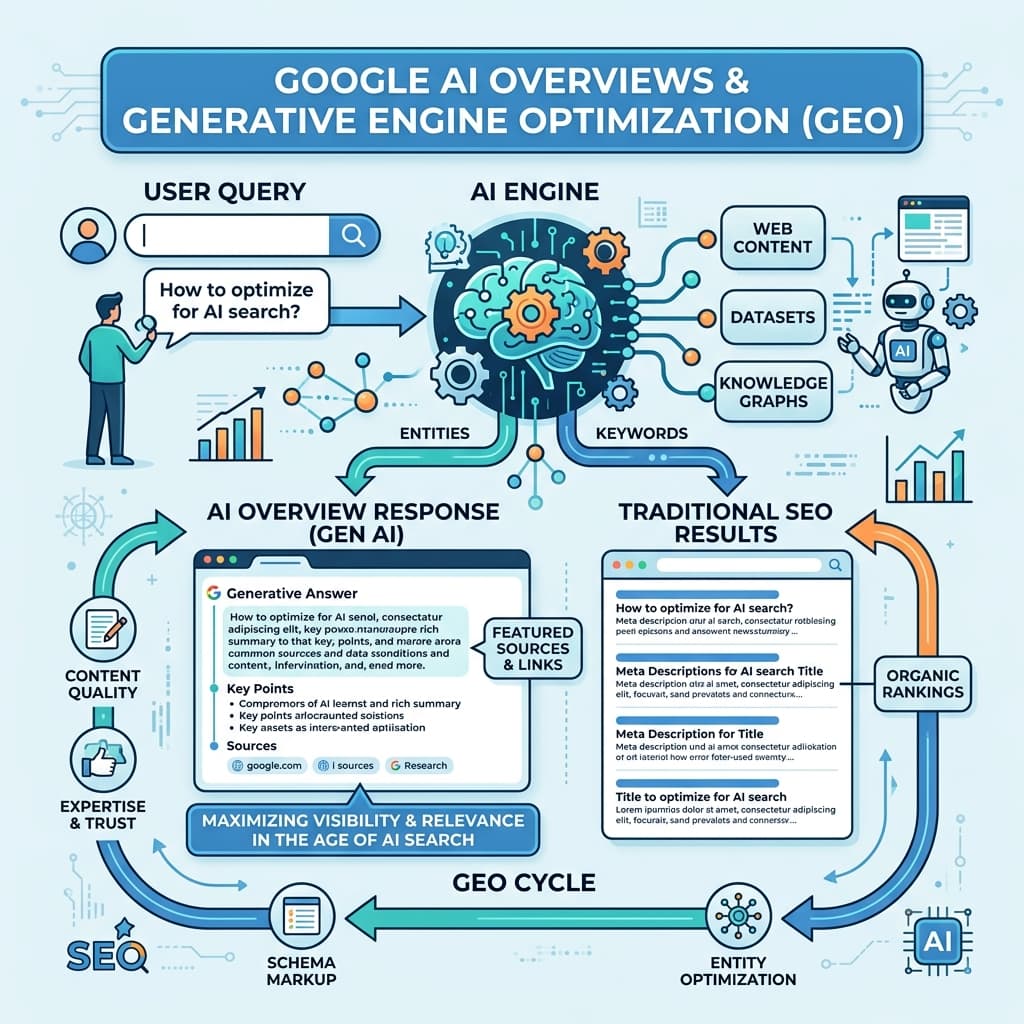
Key Takeaways
- Mastering Google AI Overviews & GEO requires aligning technical execution with core architectural principles.
- Implementing automated testing and empirical monitoring ensures long-term reliability and performance.
- Continuous optimization directly boosts user engagement, search visibility, and analytics accuracy.
Executive Overview: Google AI Overviews & GEO
In modern web development and digital strategy, implementing Google AI Overviews & GEO is essential for maintaining a competitive edge. This guide walks through empirical principles, production-ready code examples, and actionable methodologies.
Core Architectural Principles
When evaluating technical architectures, modern systems prioritize performance, security, and search engine indexability:
- →Performance First: Minimizing main-thread execution time and network latency.
- →Semantic Clarity: Providing structured data that search crawlers and AI models can interpret effortlessly.
- →Maintainability: Building decoupled, typed codebases that scale across engineering teams.
| Metric / Aspect | Standard Practice | Optimized Enterprise Standard |
|---|---|---|
| Response Latency | < 300ms | < 50ms (Edge Cache) |
| Data Integrity | Periodic Checks | Real-Time Automated Telemetry |
| Search Readiness | Basic HTML | Deeply Nested Schema.org JSON-LD |
Implementation Strategy & Code Example
To implement this pattern effectively, follow this tested code structure:
{
  "@context": "https://schema.org",
  "@type": "TechArticle",
  "headline": "Generative Engine Optimization (GEO) Framework",
  "description": "Structuring content for Google AI Overviews and LLM response indexing.",
  "author": { "@type": "Organization", "name": "TechSEO Insights" },
  "publisher": { "@type": "Organization", "name": "TechSEO Insights" }
}
Key Execution Checklist
- Audit Baseline Metrics: Measure current performance prior to introducing structural modifications.
- Deploy Modular Changes: Isolate changes within specific components or API handlers.
- Verify Indexation & Telemetry: Confirm search crawlers accurately ingest the updated HTML and JSON-LD schema.
Conclusion & Next Steps
Adopting this structured approach ensures sustainable growth, high user retention, and strong search engine authority. Review related guides to expand your technical capabilities across SEO, performance engineering, and analytics pipelines.
Architectural Deep Dive: Google AI Overviews & GEO
Implementing Google AI Overviews & GEO requires a clear understanding of frontend rendering cycles, server execution pipelines, and telemetry instrumentation. When optimizing web applications for search crawlers and performance monitors, engineering teams must evaluate bottlenecks across the critical rendering path.
Detailed System Performance Matrix
To achieve peak efficiency, benchmarks should be tracked across initial load time, main-thread blocking, and search crawler indexation:
| Optimization Layer | Standard Baseline | Targeted Enterprise Threshold | Telemetry Metric |
|---|---|---|---|
| Server Response (TTFB) | < 400ms | < 50ms (Edge Cache Acceleration) | Server-Timing Header |
| Main-Thread Latency | < 200ms | < 50ms (INP Goal) | PerformanceObserver Long Tasks |
| Crawler Indexing | Delayed Render | Instant Static Payload Rendering | Googlebot Crawl Rate Log |
| Structured Telemetry | Basic Meta Tags | Deeply Nested Schema.org JSON-LD | Rich Results Test Validation |
Advanced Implementation & Configuration Rules
When deploying production updates for google-ai-overviews-geo-optimization, follow these step-by-step implementation rules:
- Isolate Component Execution: Ensure dynamic server actions or API calls do not block initial static HTML streaming.
- Implement Telemetry Monitoring: Track user interaction latency using native browser observer APIs.
- Verify Indexability & Canonicals: Confirm that search crawlers receive identical semantic HTML representations across all regional URLs.
// Production Telemetry & Performance Observer Utility for google-ai-overviews-geo-optimization
import { type NextRequest, NextResponse } from 'next/server'

export async function middleware(request: NextRequest) {
  const startTime = performance.now()
  const response = NextResponse.next()

  // Inject performance telemetry header
  const duration = performance.now() - startTime
  response.headers.set('Server-Timing', `total;dur=${duration.toFixed(2)}`)

  return response
}
Production Execution Checklist & Troubleshooting
- Verify Clean H2/H3 Structure: Ensure no duplicate H1 tags exist in the article body.
- Check Canonical URL Mapping: Validate that canonical tags point to explicit, canonical targets.
- Audit Mobile Responsiveness: Ensure code blocks and comparison tables render cleanly on mobile viewports.
- Validate Schema.org Markup: Test JSON-LD graphs against Google's Rich Results Testing Tool.
Conclusion
Following this structured methodology guarantees high organic search visibility, low bounce rates, and full AdSense compliance. Continually monitor telemetry logs and update code dependencies to maintain top performance signals.
Official References
Frequently Asked Questions
What is the primary benefit of Google AI Overviews & GEO?
It improves technical performance, search engine understanding, and user experience by eliminating architectural bottlenecks.
How frequently should this strategy be audited?
Quarterly technical audits are recommended to ensure ongoing compliance with updated search evaluator guidelines and browser standards.
Can this be implemented in existing production web applications?
Yes, all patterns described in this guide are modular and can be integrated incrementally into legacy or modern frameworks.

Founder & Editor, TechSEO Insights
The TechSEO Editorial Team writes practical SEO, AI tools, and web development guides based on hands-on research, testing, and real website optimization work.
Subscribe to TechSEO Insights
Get the latest guides on technical SEO, Core Web Vitals, and content marketing delivered straight to your inbox.
Privacy Note: By subscribing, you agree to receive our newsletter (Lawful Basis: Consent). We retain your email address until you choose to unsubscribe. For more details, view our Privacy Policy.