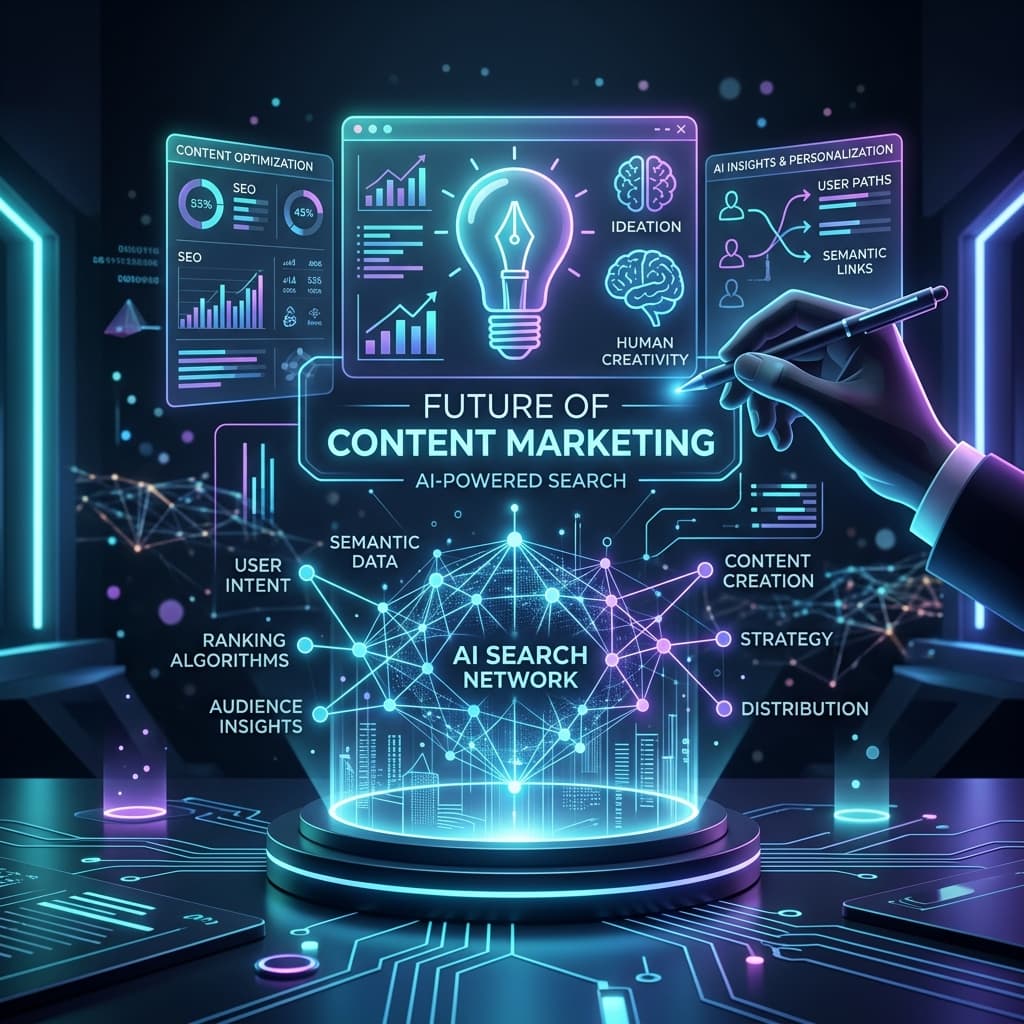
Search Everywhere Optimization: How to Win Traffic Beyond Google in the AI Search Era (2026 Guide)
Learn how to implement Search Everywhere Optimization to secure brand visibility across ChatGPT, Gemini, Perplexity, Google AI Overviews, and social engines.
Key Takeaways
- The monopoly of traditional search is fragmenting. Winning visibility in 2026 requires optimizing for ChatGPT Search, Gemini, Perplexity, and platform-specific search engines.
- Generative Engine Optimization (GEO) and Answer Engine Optimization (AEO) have replaced conventional keyword stuffing with information gain and semantic entity-relationship mapping.
- AI search engines run on Retrieval-Augmented Generation (RAG) pipelines, which prioritize original statistics, expert citations, and technical schema markup to verify claims.
- A resilient content marketing strategy must focus on owned audience channels and direct brand searches to mitigate the traffic loss from zero-click search interfaces.
The landscape of digital marketing has reached a critical inflection point. For nearly three decades, search engine optimization meant one thing: optimizing for Google. As long as you satisfied Google's algorithms, you secured a steady flow of organic traffic and brand growth.
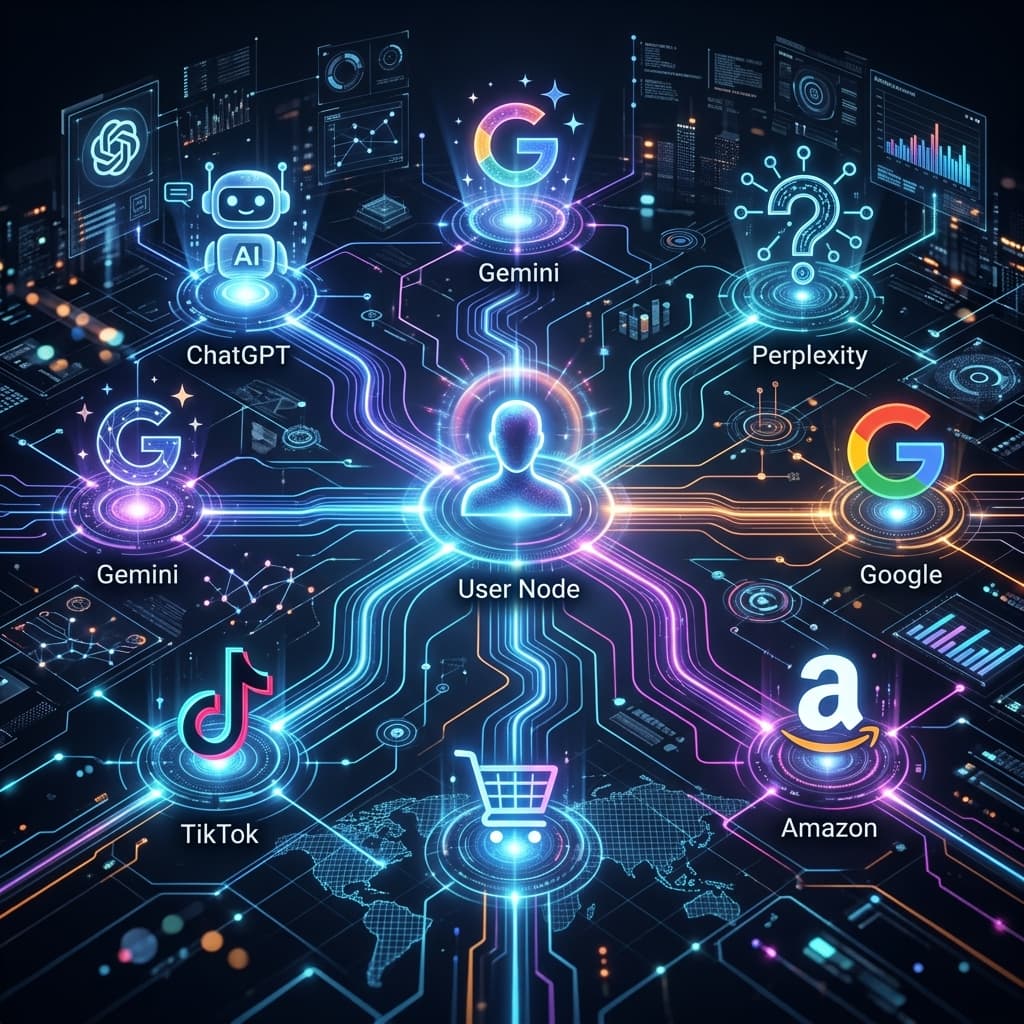
In the AI search era, that single-channel monopoly is fragmenting. Today, user behavior is undergoing a profound decentralization. Users are bypassing traditional search bars entirely, opting instead for conversational answers on ChatGPT, investigative research on Perplexity, quick visual searches on TikTok, or commercial queries on Amazon.
This structural shift has given rise to Search Everywhere Optimization—an omnichannel approach designed to maximize brand visibility across every platform where modern users search for answers.
To win in this new environment, marketers and technical SEOs must look beyond the traditional "ten blue links" framework. We must master the mechanics of AI Search Optimization, adapt to the rise of the Zero-Click Search, and build a resilient Content Marketing Strategy optimized for both humans and machines.

1. The Fragmentation of Modern Content Discovery
The unified search experience of the early 2000s is gone. Traditional search engines have evolved from index directories into active synthesis systems.
At the center of this change is the rapid adoption of conversational AI. When a user wants to solve a programming bug, compare complex software architectures, or research historical trends, they no longer scan a page of search results. They ask an AI assistant for a synthesized summary.
This evolution is characterized by several distinct search environments:
Google AI Overviews & AI Mode
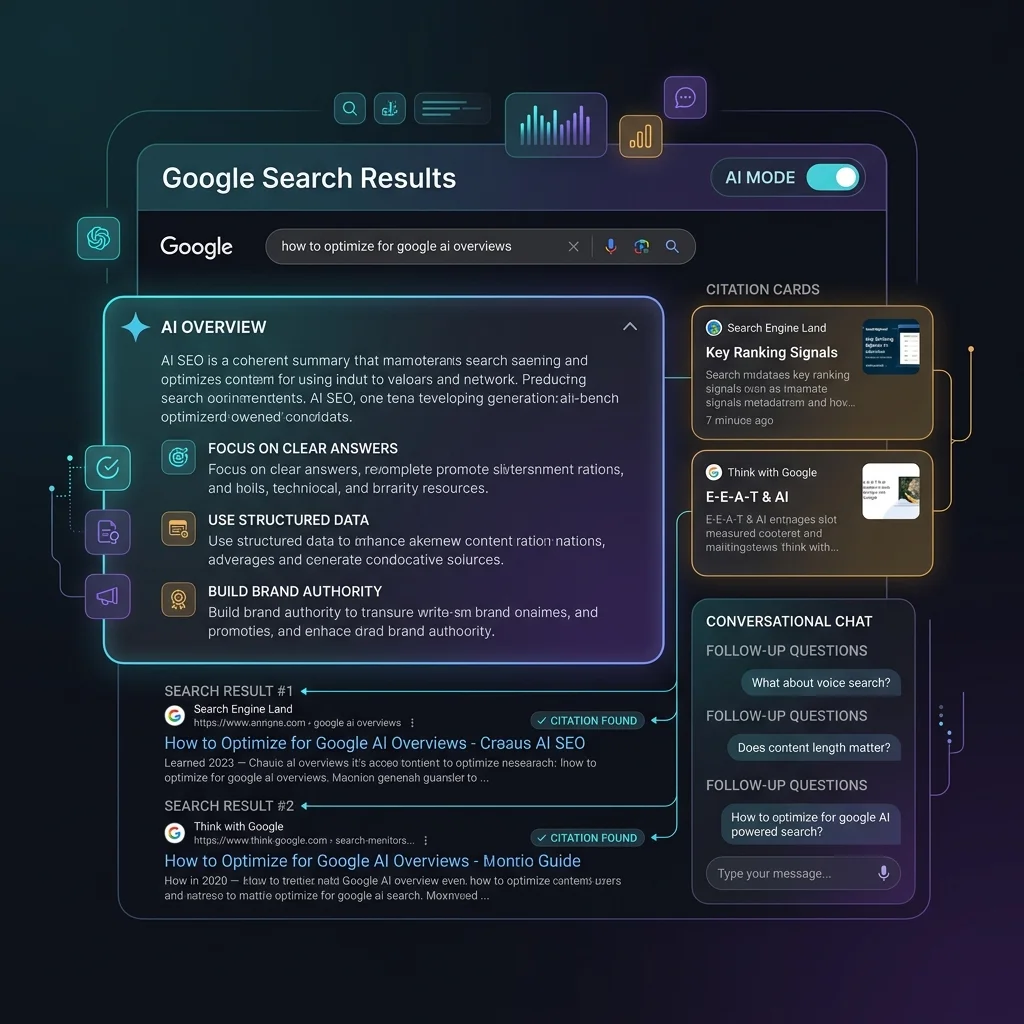
Google has integrated Gemini directly into its core search interface. Google AI Overviews use generative AI to synthesize answers for complex queries directly at the top of the search results page. Meanwhile, Google's AI Mode offers a persistent conversational chat interface that maintains session history. The result is a sharp increase in zero-click searches, as users find their answers without ever visiting the primary source websites. To learn the inner workings of Google's system, read our guide on Google AI Overviews and AI Mode SEO.Dedicated Answer Engines
Platforms like Perplexity AI and ChatGPT Search have emerged as major alternatives for informational search. Rather than listing pages, these engines read the live web in real time, extract the most relevant facts, and construct a cohesive response annotated with inline citations. Because these engines prioritize high-trust, authoritative sources, appearing as a cited reference is the new equivalent of ranking position one.Platform-Specific Search
Search is no longer confined to traditional browsers. Younger demographics increasingly use TikTok and YouTube as their primary engines for how-to guides, product reviews, and lifestyle recommendations. Simultaneously, commercial product searches begin directly on Amazon or specialized e-commerce marketplaces.To survive this shift, brands must expand their scope from traditional search engines to a holistic philosophy of Search Experience Optimization.
2. Defining Search Everywhere Optimization
Search Everywhere Optimization is the strategic process of optimizing your brand’s digital footprint so that it is recommended, cited, and surfaced by every digital channel a user might employ to discover information.
Unlike traditional SEO, which focuses on satisfying a singular keyword algorithm, Search Everywhere Optimization is built around entity relationships, semantic relevance, and multi-channel content distribution.
graph TD
    A[Central Brand Entity] --> B(Traditional SEO)
    A --> C(AI Search Optimization)
    A --> D(Social & Platform Search)

    B --> B1[Google Search Console]
    B --> B2[Technical Page Speed]

    C --> C1[ChatGPT Search]
    C --> C2[Gemini Search]
    C --> C3[Perplexity AI]

    D --> D1[TikTok Search]
    D --> D2[YouTube & Video SEO]
    D --> D3[Amazon & E-commerce]
The Transition to GEO and AEO
Within this framework, two sub-disciplines have emerged as foundational to modern visibility:- Generative Engine Optimization (GEO): The process of structuring and writing content specifically to be cited and recommended by generative AI models like OpenAI's GPT-4o, Google's Gemini, and Anthropic's Claude.
- Answer Engine Optimization (AEO): The practice of designing content to answer direct, conversational user queries. AEO is optimized for voice search, chat interfaces, and quick-answer features.
3. The Retrieval-Augmented Generation (RAG) Pipeline
To optimize for AI engines, you must understand how they collect information. AI engines do not search the web in the same way traditional web crawlers do. Instead, they use a process called Retrieval-Augmented Generation (RAG).
When a user submits a query to an engine like Perplexity or ChatGPT Search, the system executes a multi-step pipeline:
sequenceDiagram
    participant User
    participant AI_Engine as AI Search Engine
    participant Index as Search Index (Bing/Google)
    participant Web as Live Web Pages

    User->>AI_Engine: Submits conversational query
    AI_Engine->>Index: Retrieves highly relevant web documents
    Index->>AI_Engine: Returns top document URLs & snippets
    AI_Engine->>Web: Pulls full text from selected pages
    AI_Engine->>AI_Engine: Semantic Parsing & Vector Embedding
    AI_Engine->>AI_Engine: Synthesizes final response
AI_Engine->>User: Returns answer with inline citations- Query Expansion: The AI engine translates the user's conversational prompt into a search query optimized for vector databases and web index search.
- Document Retrieval: The engine queries a traditional web index (such as Google’s search index or Bing's index API) to fetch the top-ranking web pages matching the query.
- Semantic Chunking: The engine extracts the raw text from those pages, parses the content, and breaks it into smaller chunks.
- Vector Comparison: The chunks are converted into vector embeddings and compared against the user's query vector to find the exact sentences or paragraphs that contain the answer.
- Synthesis and Citation: The LLM merges these extracted chunks, removes redundancies, and generates a natural-language answer, adding numbered citations pointing to the source pages.
4. Key Factors in Generative Engine Optimization (GEO)
Recent academic and industry studies on Generative Engine Optimization have identified several clear, measurable techniques that significantly increase the probability of an LLM citing your website:
Information Gain and Uniqueness
AI models are trained on existing web data. If your page simply compiles and repeats what is already out there, it provides no "Information Gain." To be cited, your content must include original data, proprietary research, custom case studies, or first-hand expert quotes. LLMs are highly tuned to prioritize new, unique facts over generic summaries. To see why this is critical for modern content marketing, read The Future of Content Marketing: What Works After AI Search.Statistical and Factual Density
GEO research shows that including precise quantitative data, statistics, and verifiable facts significantly improves your chances of being cited. AI engines look for concrete answers to validate their output. For example, instead of writing *"Our software dramatically reduces page load times,"* write *"Our Next.js optimization framework reduces largest contentful paint (LCP) by 42% on average."*Authoritative Citation Support
AI search engines are sensitive to hallucinations. They evaluate the trustworthiness of sources using algorithms similar to Google's E-E-A-T guidelines (Experience, Expertise, Authoritativeness, and Trustworthiness). If your content links out to highly reputable academic papers, official documentation, or trusted news sources, the AI model views your page as a reliable node in the web graph and is more likely to trust and cite your analysis.Formatting and Readability
Clear formatting makes chunking easier for RAG pipelines. Use:- →Structured tables to present comparative data.
- →Bullet points for lists of steps or features.
- →Clear heading hierarchies (
h2,h3) written as direct questions. - →Bold text for primary keywords and key phrases to draw the parser’s attention.
5. Optimizing for the Top AI Search Channels
Each AI search platform uses a slightly different tech stack and retrieval methodology. To build a successful Search Everywhere Optimization campaign, you must customize your workflow for each channel.
Optimizing for ChatGPT Search
ChatGPT Search relies heavily on the Bing index, combined with direct API partnerships with major publishers.- →Actionable Step: Ensure your site is fully indexed on Bing by submitting your sitemap to Bing Webmaster Tools.
- →Crawl Permissions: Verify that your
robots.txtdoes not blockOAI-SearchBotorGPTBot. - →Semantic Markup: Implement clear JSON-LD schema to define your brand’s entity relationship.
- →Structured Content: ChatGPT prefers clean Markdown structures. Use bullet points and concise paragraphs that can be directly extracted.
Optimizing for Perplexity AI
Perplexity is designed to be an investigative tool, emphasizing factual accuracy and real-time news retrieval.- →Actionable Step: Ensure your site is crawlable by
PerplexityBot. - →Factual Density: Write in a direct, encyclopedia-like tone. Perplexity frequently pulls data from tables and structured comparison charts.
- →Digital PR: Perplexity often cites Reddit, Quora, and major media outlets. Ensure your brand is active and mentioned positively across external communities and forums.
Optimizing for Gemini Search
Gemini is deeply integrated into Google’s ecosystem. It draws directly from Google's Knowledge Graph and live search index.- →Actionable Step: Optimize for Google's E-E-A-T guidelines by including author bios, expert reviews, and links to verified social media profiles. Refer to our playbook on How to Use AI for SEO Content Writing to learn how to keep quality high.
- →Schema.org: Use comprehensive JSON-LD schema (such as
TechArticle,ProfilePage, andProduct) to give Google explicit metadata. - →Google Business Profile: For local searches, ensure your profile is complete and regularly updated, as Gemini pulls heavily from local map packs.
6. Comparison: Traditional SEO vs. Generative Engine Optimization (GEO)
To help your team pivot their workflow, we have compiled the core differences between traditional search engine optimization and generative engine optimization:
| Metric / Aspect | Traditional SEO | Generative Engine Optimization (GEO) |
|---|---|---|
| Primary Goal | Rank in the top 10 search results. | Get cited as a source in generative summaries. |
| Search Intent | Keyword-based (e.g., "best SEO tools"). | Conversational / Semantic (e.g., "compare top SEO tools for small business"). |
| Content Focus | Skyscraper content, keyword density. | High Information Gain, unique stats, SME quotes. |
| Retrieval Engine | PageRank, link graphs, keyword indexing. | RAG pipelines, vector search, entity linking. |
| Structure | Standard paragraph blocks, internal links. | Structured tables, direct Q&A headers, lists. |
| Primary crawlers | Googlebot, Bingbot. | GPTBot, OAI-SearchBot, PerplexityBot, Google-Extended. |
| Key Metric | Organic clicks, impressions, rank position. | LLM Share of Voice (SOV), reference traffic, brand search volume. |
7. Technical Implementation: JSON-LD Schema for AI Retrieval
Structured schema markup acts as a translator for AI crawlers. By providing a clean JSON-LD block, you define the semantic entities, authorship, and factual claims of your article, making it much easier for a RAG model to verify your page's authority.
Here is a comprehensive JSON-LD schema example that you should implement on your article pages. It includes explicit entity definitions (about and mentions) linking to Wikipedia or Wikidata resources, as well as author verification:
<script type="application/ld+json">
{
  "@context": "https://schema.org",
  "@type": "TechArticle",
  "headline": "Search Everywhere Optimization: How to Win Traffic Beyond Google",
  "description": "A comprehensive guide to Search Everywhere Optimization, Generative Engine Optimization (GEO), and ranking in AI search engines like ChatGPT, Gemini, and Perplexity.",
  "inLanguage": "en-US",
  "mainEntityOfPage": {
    "@type": "WebPage",
    "@id": "https://www.seotech.app/blog/search-everywhere-optimization"
  },
  "image": {
    "@type": "ImageObject",
    "url": "https://www.seotech.app/images/blog/search-everywhere-optimization.png",
    "width": 1200,
    "height": 1200
  },
  "datePublished": "2026-06-26T12:00:00Z",
  "dateModified": "2026-06-26T12:00:00Z",
  "author": {
    "@type": "Person",
    "name": "TechSEO Editorial Team",
    "jobTitle": "Founder & Editor",
    "worksFor": {
      "@type": "Organization",
      "name": "TechSEO Insights",
      "url": "https://www.seotech.app"
    },
    "sameAs": [
      "https://github.com/techseo-editorial-team"
    ]
  },
  "publisher": {
    "@type": "Organization",
    "name": "TechSEO Insights",
    "url": "https://www.seotech.app",
    "logo": {
      "@type": "ImageObject",
      "url": "https://www.seotech.app/images/logos/logo.svg"
    }
  },
  "about": [
    {
      "@type": "Thing",
      "name": "Search Engine Optimization",
      "sameAs": "https://en.wikipedia.org/wiki/Search_engine_optimization"
    },
    {
      "@type": "Thing",
      "name": "Artificial Intelligence",
      "sameAs": "https://en.wikipedia.org/wiki/Artificial_intelligence"
    }
  ],
  "mentions": [
    {
      "@type": "Thing",
      "name": "ChatGPT",
      "sameAs": "https://en.wikipedia.org/wiki/ChatGPT"
    },
    {
      "@type": "Thing",
      "name": "Perplexity AI",
      "sameAs": "https://en.wikipedia.org/wiki/Perplexity_AI"
    }
  ]
}
</script>
Implementing this script in your Next.js frontend or headless CMS configuration ensures that crawlers don't have to guess who wrote the content, who publishes it, or what topics and entities it covers.
8. Designing a Omnichannel Content Marketing Strategy
If your target audience is searching everywhere, your content marketing strategy must be everywhere. You cannot afford to rely on a single channel for your customer acquisition.
Here is how to design a resilient, omnichannel content engine in 2026:
Diversified Content Distribution
Create a core content asset, such as a deep-dive research report, and repurpose it systematically across different channels:- Long-Form Article: Publish the primary guide on your website, optimized for technical SEO and GEO.
- Visual Video: Summarize the core takeaways in a short-form video for TikTok and YouTube Shorts. Focus on high-intent search terms in the video title and description.
- Conversational Threads: Share the findings as a detailed thread on LinkedIn and X, encouraging discussion and brand mentions.
- Audio Content: Discuss the research findings in a podcast episode, submitting the transcript to search indexes.
Building Owned Audience Channels
Because organic traffic is subject to search engine volatility, you must capture and own your audience.- →Email Newsletters: Encourage readers to subscribe by offering high-value downloads (spreadsheets, templates, checklists). An email list is a direct channel that no algorithm can disrupt.
- →Private Communities: Build a Slack, Discord, or custom forum for your industry. Engaging directly with your users fosters brand loyalty and keeps them coming back to your site directly.
- →Direct Brand Searches: The ultimate defense against traffic loss is a strong brand. When users search for your specific company name rather than a generic term, they bypass search summaries and land directly on your site.
9. Measuring Success: The KPIs that Matter Now
In the AI search era, traditional organic traffic metrics do not tell the whole story. If a user reads a detailed summary of your product on ChatGPT Search and then navigates directly to your homepage to sign up, traditional GA4 attribution might classify that user as "Direct" traffic, missing the impact of your SEO work.
To measure Search Everywhere Optimization effectively, you should track these updated KPIs:
- LLM Share of Voice (SOV): Measure how often your brand is mentioned or cited by AI models (ChatGPT, Gemini, Perplexity) when queried about your industry or product niche.
- AI Referral Traffic: Monitor referral traffic from AI search domains (e.g.,
perplexity.ai,chatgpt.com). While small compared to traditional Google search traffic, this traffic represents highly qualified, deep-funnel buyers. - Brand Search Volume: Track the number of users typing your brand name directly into search engines. A rising trend indicates that your off-page presence and content distribution strategies are successfully driving brand awareness.
- Conversion Path Triangulation: Implement GA4 custom tracking to analyze multi-touch journeys. Pay close attention to users who visit your pricing page or book a demo shortly after landing from direct or brand-search channels. Review our Website Analytics Audit Checklist to make sure your tracking matches this.
10. Official References
- →Google Search Central: Creating Helpful, Reliable, People-First Content
- →Google Search Central Blog: Google's Guidance on AI-Generated Content
- →OpenAI: Introducing SearchGPT Prototype
- →Perplexity AI: Factual Accuracy and Source Citing
- →Microsoft Clarity: Analyzing UX Friction and Dead Clicks
11. Conclusion
Search Everywhere Optimization is not a temporary trend; it is the new reality of how information is discovered. The era of optimizing solely for Google's traditional index is coming to an end.
By restructuring your content to satisfy RAG pipelines, optimizing for platforms like ChatGPT and Perplexity, and building a diversified content distribution network, you can build a resilient digital presence that captures high-quality traffic from every corner of the web.
Remember: AI models do not generate knowledge; they synthesize it. The brands that continue to produce original research, expert insights, and clear, structured facts will always remain the foundation upon which the future of search is built.
To further optimize your site for generative search, check out our deep dives on Content Marketing in 2026: Why AI Alone is Not Enough, GA4 Consent Mode v2 Explained, and B2B Content Marketing Strategy.
Frequently Asked Questions
What is Search Everywhere Optimization?
Search Everywhere Optimization is the strategic practice of optimizing a brand's digital presence so that it is discoverable, recommended, and cited across all platforms where users search for information. This includes AI answer engines (ChatGPT Search, Perplexity, Gemini), traditional search engines, social media platforms (TikTok, YouTube), and e-commerce marketplaces (Amazon).
How does Generative Engine Optimization (GEO) differ from traditional SEO?
Traditional SEO focuses on optimizing for keywords, page speed, and backlinks to rank in Google's ten blue links. GEO focuses on optimizing content structure, semantic completeness, and factual density so that Large Language Models (LLMs) can ingest, summarize, and cite the content within their generated conversational answers.
What is the impact of Zero-Click Search on web traffic?
Zero-click search occurs when an AI engine or search feature answers a query directly on the search results page, eliminating the user's need to click through to a website. To counter this, brands must optimize for high-intent queries that require deeper engagement, and build direct relationships with their audience via email lists and communities.
How do I get my brand cited in ChatGPT Search and Perplexity?
To get cited by conversational AI engines, ensure your website is crawlable by their user-agents (like OAI-SearchBot and PerplexityBot), structure content with direct question-answer headers, include unique statistical data, mark up pages with JSON-LD schema, and build strong external mentions across authoritative industry databases.
Why is schema markup critical for AI Search Optimization?
Schema markup (JSON-LD) provides search engine crawlers and LLM retrieval pipelines with structured semantic facts about your content. By explicitly defining entities, authors, products, and organizations, you help AI systems resolve ambiguity and trust the validity of your claims, making your site a preferred source for citations.

Founder & Editor, TechSEO Insights
The TechSEO Editorial Team writes practical SEO, AI tools, and web development guides based on hands-on research, testing, and real website optimization work.
Subscribe to TechSEO Insights
Get the latest guides on technical SEO, Core Web Vitals, and content marketing delivered straight to your inbox.
Privacy Note: By subscribing, you agree to receive our newsletter (Lawful Basis: Consent). We retain your email address until you choose to unsubscribe. For more details, view our Privacy Policy.