Google AI Overviews and AI Mode SEO: A Practical Visibility Framework (2026)
An in-depth guide to achieving high visibility in Google AI Overviews and AI Mode conversational search. Learn the RAG pipeline, key ranking factors, E-E-A-T requirements, and structured data optimization.
Advertisement
Key Takeaways
- Google AI Overviews and AI Mode utilize a Retrieval-Augmented Generation (RAG) pipeline to fetch, parse, and synthesize responses from the web.
- Generative engine visibility depends heavily on informational gain, semantic clarity, active voice, and explicit structured comparison tables.
- Rigorous E-E-A-T and validated JSON-LD schema (Article, ProfilePage, FAQPage) are critical for securing high-trust AI search citations.
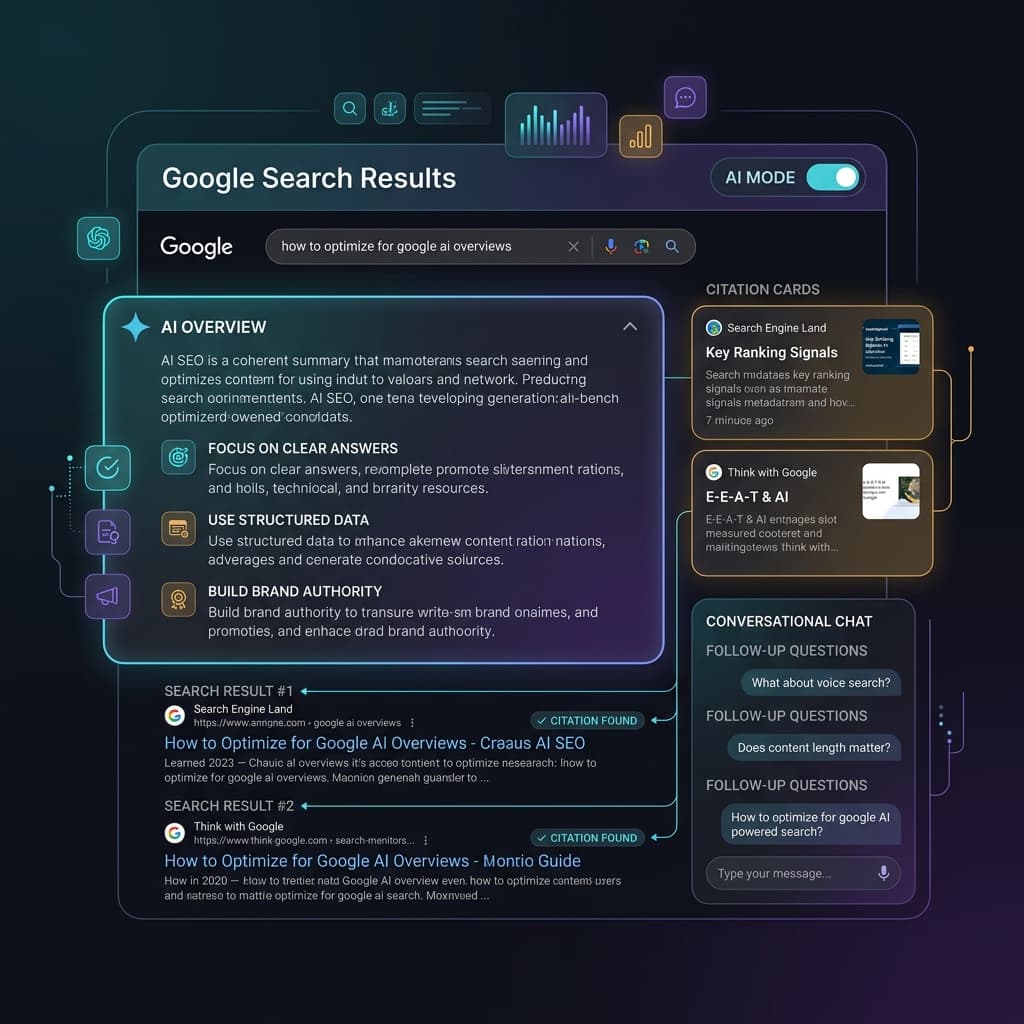
Organic search in 2026 has transitioned into a highly sophisticated ecosystem of direct answer synthesis. Search engines are no longer simple indices serving lists of destination URLs. Instead, Google has evolved into a conversational discovery platform. At the center of this paradigm shift are Google AI Overviews and the newly integrated AI Mode. These interfaces present a unique challenge: they summarize web information directly on the SERP, capturing click-through attention before users can navigate to traditional organic listings.
For technical SEOs and content strategists, achieving high search visibility now requires optimizing for these AI-driven features. In this guide, we break down how Google's retrieval and synthesis models operate and present an actionable framework to optimize your content for AI overviews and conversational search queries.
1. Introduction: The Generative Search Revolution
The organic search landscape has undergone its most seismic transformation since the introduction of mobile indexing. In 2026, search is no longer just a system of indexing and retrieval that serves ten blue links. Instead, search engine platforms have evolved into dynamic answer engines, with Google’s search interfaces shifting towards Generative Search Optimization (GSO) and conversational intelligence.At the center of this transformation are Google AI Overviews (formerly Search Generative Experience, or SGE) and the conversational "AI Mode." Together, these features represent a future where a significant portion of user queries are resolved directly inside the search interface, without a user ever clicking through to a website. For search engine optimization specialists, this paradigm shift is both a challenge and a massive opportunity. Surviving and thriving in this new landscape requires shifting from traditional keyword-centric tactics to a robust, entity-driven ai search visibility framework.
To win in the era of generative AI search, technical SEOs must understand how LLMs synthesize information, how retrieval-augmented generation (RAG) selects citations, and how to structure content so that Google's Gemini-driven systems can easily extract, summarize, and attribute it. This guide provides a premium, expert-level framework for achieving high AI search visibility in 2026.
2. What Are Google AI Overviews?
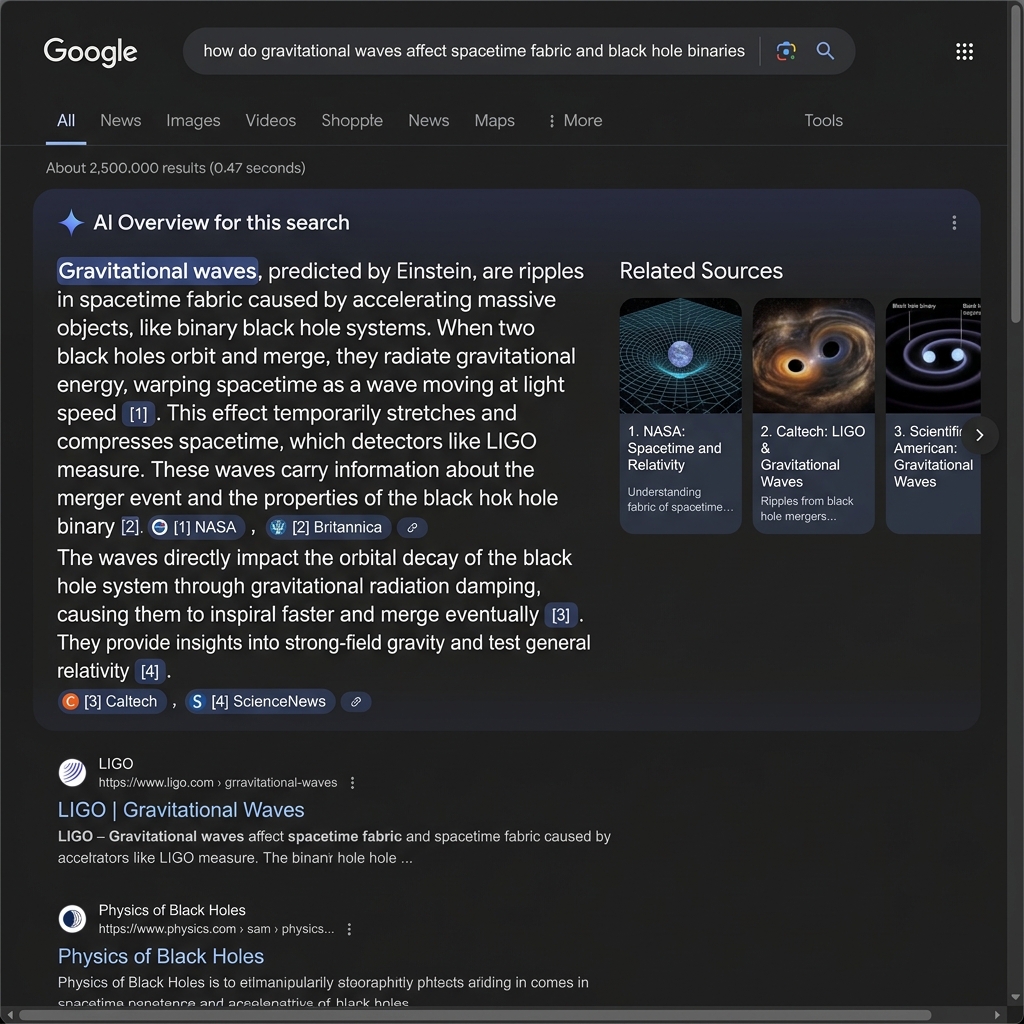
Google AI Overviews are AI-generated, synthesized answers that appear at the very top of Google search engine results pages (SERPs) for informational, commercial, and complex multi-part queries. Powered by Google's custom Gemini models, AI Overviews analyze the top organic search results in real time, extract key facts, and synthesize a cohesive response that directly answers the user's intent.Crucially, AI Overviews are not static text blocks. They are highly interactive units featuring:
- →Carousel Citations: Card-style links displaying the source publication's name, logo, title, and featured image, positioned prominently next to or above the generated text.
- →Inline Link Attributions: Text hyperlinks embedded directly into the synthesized paragraphs, allowing users to verify facts and dive deeper into specific source materials.
- →Expandable Accordions: Collapsible dropdowns containing detailed sub-points, lists, and tables extracted from source documents.
3. What Is Google AI Mode?
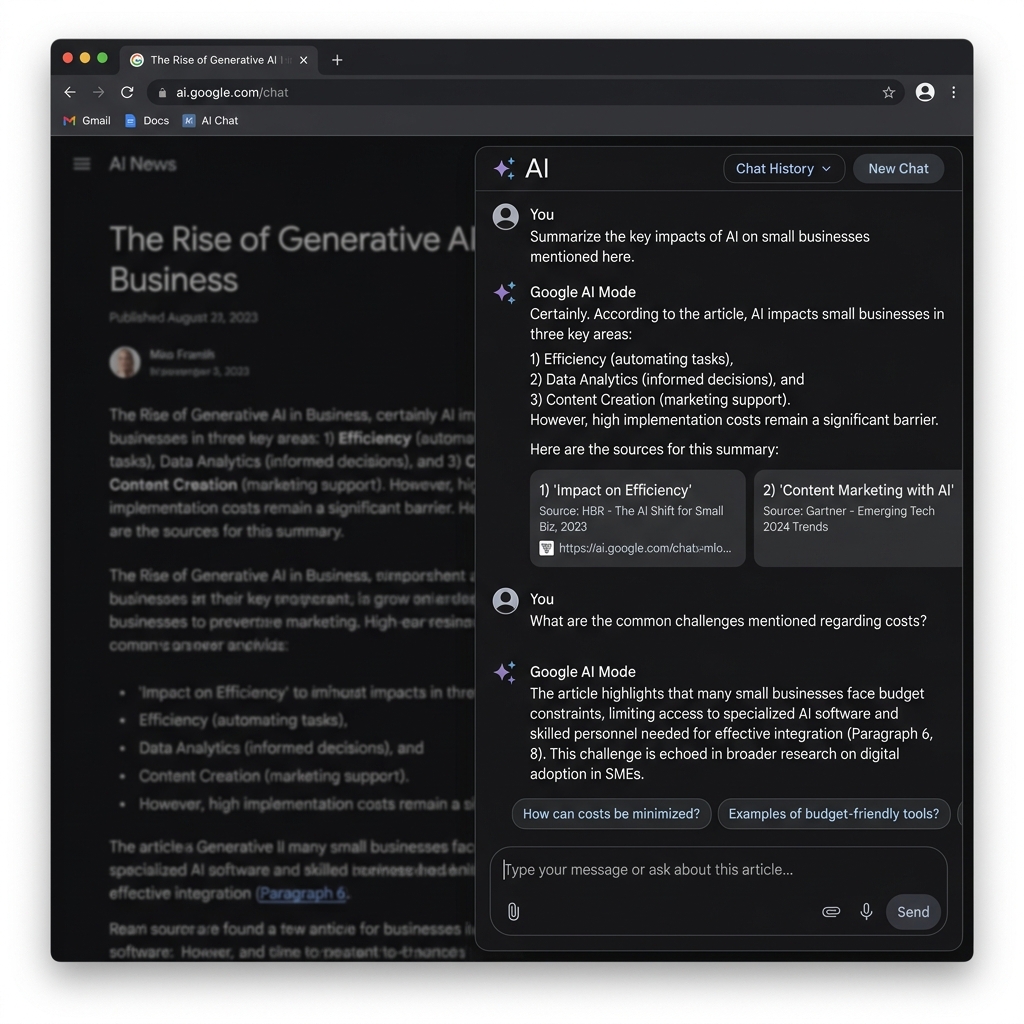
While AI Overviews act as static summaries embedded in the standard search results, "AI Mode" is a fully immersive, conversational interface. When a user toggles AI Mode (or taps "Ask a follow-up" within an AI Overview), the search interface transitions into a persistent chat assistant.AI Mode represents a shift from transactional, single-query search sessions to conversational research paths. Key characteristics of AI Mode include:
- →Context Retention: The AI remembers the history of the conversation, allowing users to ask follow-up questions without repeating the core context.
- →Intent Refinement: As the conversation progresses, the system refines its search queries behind the scenes, pulling in new sources to answer specific follow-up prompts.
- →Interactive Multi-Modal Inputs: Users can upload images, scan text, and use voice commands to interact with the assistant in real-time.
4. How AI Search Differs From Traditional Search
To build an effective optimization strategy, we must first understand the fundamental differences between traditional search engine indexing and generative search engines.Traditional search relies on semantic indexing, keyword matching, and page-level ranking algorithms (like PageRank) to match a query with a list of relevant web documents. The user is responsible for clicking on multiple links, reading the pages, and synthesizing the final answer themselves.
Generative AI search, on the other hand, shifts the synthesis step from the user to the search engine. Google's RAG pipeline retrieves relevant documents, reads them, and compiles a single, synthesized response. The search engine becomes the direct answer provider, and websites serve as cited sources backing up those answers.
Here is a comparison of key parameters between the two paradigms:
| Feature/Parameter | Traditional Organic Search | Generative AI Search (AI Overviews & AI Mode) |
|---|---|---|
| User Experience | Ten blue links; users click and synthesize. | Synthesized, direct answers with inline citations. |
| Search Intent Matching | Literal keyword mapping & topical clustering. | Conceptual understanding of multi-part conversational prompts. |
| Click-Through Behavior | Distributed across top-ranking organic links. | Highly concentrated on cited sources in the AI Overview. |
| Crawl & Retrieval Speed | Standard Googlebot crawl and indexing cycles. | Real-time retrieval-augmented generation (RAG) lookups. |
| Key Ranking Metrics | PageRank, backlink quantity, keyword optimization. | Semantic match, citation authority, formatting clarity, E-E-A-T. |
5. How Google Chooses Sources For AI Answers
How does Google decide which websites to cite in an AI Overview or AI Mode conversation? The answer lies in the architecture of Google's Retrieval-Augmented Generation (RAG) pipeline.When a query is entered, the search engine does not simply pass the prompt to a large language model. LLMs are prone to hallucination and lack real-time information. Instead, Google's system executes a multi-step pipeline:
- Retrieval Phase: Google’s search core runs a high-speed search across its traditional index to find the most relevant, high-quality documents that address the user's query.
- Context Selection: The system extracts key passages and semantic snippets from these top retrieved documents.
- Synthesis Phase: These snippets are fed into the Gemini model as context alongside the user's original prompt. The model is instructed to write a summary based *only* on the provided context.
- Attribution & Verification: The model aligns its synthesized output with the original source passages. It inserts inline citations and carousel links pointing back to the exact documents that provided the facts.
6. Ranking Signals That Influence AI Visibility
In generative search, standard on-page SEO is no longer sufficient. Optimizing for generative visibility requires focusing on specific ai search ranking factors that align with how large language models parse and summarize data.Semantic Density and Information Gain
Generative engines prioritize pages that offer high "information gain"—that is, pages that provide unique, original insights rather than repeating facts found on hundreds of other sites. If your article is a rehash of competitor pages, Gemini has no incentive to cite it. You must include original statistics, proprietary case studies, expert quotes, or unique diagrams.Linguistic Alignment and Clarity
AI models prefer content written with clear, logical sentence structures. Complex, passive phrasing can confuse parsing algorithms. Use active voice, direct definition sentences, and clear subject-predicate relationships. For instance, instead of writing: *"A method that is often utilized by developers for the purpose of decreasing layout shifts is the reservation of ad containers,"* write: *"Developers prevent Cumulative Layout Shift (CLS) by reserving ad container dimensions in CSS."*Citation Authority and Trust
Because Google must avoid generating false or harmful summaries (especially in Your Money Your Life—YMYL—verticals), it filters potential sources through strict trust thresholds. The authority of your brand, the quality of your backlink profile, and your digital footprint play a major role in whether your page is deemed safe for citation.7. E-E-A-T Requirements For AI Search
Google's Quality Rater Guidelines emphasize E-E-A-T: Experience, Expertise, Authoritativeness, and Trustworthiness. In the context of AI search, E-E-A-T is not just a theoretical guideline; it is a critical filter for the retrieval pool.When synthesizing answers on medical, financial, or technical topics, Google’s systems must verify that the source material comes from a qualified entity. If you are writing about complex technical search visibility, you must demonstrate real-world experience. For a deep dive into maintaining these trust factors when using assistive tools, read our guide on AI SEO Content Writing.
To satisfy E-E-A-T requirements for AI search:
- →Cite Real Experts: Ensure every piece of content is written or reviewed by a recognized expert in the field. Include their bio, credentials, and links to their active professional profiles.
- →Maintain Entity Consistency: Use structured data to clearly identify authors, organizations, and their connections. If an author is recognized as an expert in Next.js, Google’s Knowledge Graph should easily link their name to published works, speaking engagements, and code repositories.
- →Provide Verifiable Data: Back up all claims with primary sources, official documentation, or proprietary datasets. Generative models look for factual consistency across multiple verified websites.
8. Content Formats That Perform Best In AI Overviews
To improve your chances of appearing in AI Overviews, you must present information in formats that align with Gemini’s preferred output styles. When the search model synthesizes an answer, it often structures its response as a list, a table, or a direct definition. By pre-formatting your content this way, you make it easy for the model to retrieve your data intact.Direct Definition Blocks
For informational search terms (e.g., "what is generative search optimization"), place a concise, two-to-three-sentence definition at the very top of your section. Use the formula: [Term] is [Definition] + [Context/Importance]. Example: > "Generative Search Optimization (GSO) is the practice of optimizing digital assets to be retrieved, synthesized, and cited by AI-driven search engines. It focuses on semantic formatting, entity authority, and high-information-gain content structures."Structured Comparison Tables
AI Overviews frequently generate tables to compare products, tools, or strategies. If your page contains a clean, semantic HTML table comparing these elements, Google's model is highly likely to import your table directly into the AI Overview box.Bulleted and Numbered Checklists
Step-by-step queries (e.g., "how to audit schema markup") are almost always answered with numbered lists in AI Overviews. Ensure your articles break down complex workflows into clear, sequential lists using standard markdown syntax.9. Structured Data & Schema Recommendations
Structured data is the primary mechanism for communicating semantic meaning directly to search engine bots. While traditional schema markup helps win rich snippets, it is even more critical for generative search optimization because it helps Google’s Knowledge Graph connect entities, topics, and authors.For a comprehensive foundation on structured data best practices, consult our Structured Data & Schema Markup Guide.
When optimizing for AI search, prioritize the following schema types:
- Article Schema (
@type: Article): Clearly defines the headline, date published, date modified, author, and publisher of your content. Ensure thedateModifiedproperty is updated whenever you refresh the content, as AI engines favor fresh, up-to-date sources. - ProfilePage Schema (
@type: ProfilePage): Connects the author of the article to their credentials, social media profiles, and areas of expertise. This feeds directly into Google’s E-E-A-T entity matching. - FAQPage Schema (
@type: FAQPage): Outlines clear question-and-answer pairs, making it simple for AI Mode to extract direct answers for conversational follow-up queries.
Technical Implementation Example
Here is the recommended JSON-LD structure for an expert-written article optimized for AI search:{
"@context": "https://schema.org",
"@type": "TechArticle",
"headline": "Google AI Overviews and AI Mode SEO: A Practical Visibility Framework",
"description": "Learn how to optimize your digital assets for Google AI Overviews and conversational AI Mode with our technical SEO framework.",
"inLanguage": "en-US",
"mainEntityOfPage": {
"@type": "WebPage",
"@id": "https://www.seotech.app/blog/google-ai-overviews-ai-mode-seo"
},
"datePublished": "2026-06-17T12:00:00Z",
"dateModified": "2026-06-17T12:00:00Z",
"author": {
"@type": "Person",
"name": "Daniel Ashcroft",
"jobTitle": "Technical SEO Specialist",
"sameAs": [
"https://linkedin.com/in/danielashcroft",
"https://github.com/danielashcroft"
]
},
"publisher": {
"@type": "Organization",
"name": "TechSEO Insights",
"logo": {
"@type": "ImageObject",
"url": "https://www.seotech.app/logo.png"
}
},
"keywords": "google ai overviews seo, ai mode seo, optimize for ai overviews, ai search visibility"
}10. Internal Linking Strategies
Internal linking is one of the most powerful tools in a technical SEO's arsenal. In the era of AI search, internal links serve a dual purpose: they guide search engine crawlers through your site architecture, and they establish topical authority around key entity nodes.When building a generative search visibility strategy, you must organize your content into strict topic clusters. Each cluster should focus on a core theme, with a central pillar page linking to and receiving links from supporting sub-topics. For a step-by-step guide on structuring these relationships, read our Content Marketing Strategy Framework.
To maximize the impact of your internal links for AI search:
- →Use Entity-Rich Anchor Text: Avoid generic anchors like "click here" or "read more." Instead, use descriptive anchors that define the relationship between the pages (e.g., "read our guide on How to Create SEO-Friendly Content").
- →Establish Two-Way Contextual Links: Ensure that your pillar page links to all supporting cluster articles, and that each cluster article links back to the pillar page. This signals deep topical authority to Google’s indexing engines.
- →Maintain Link Proximity: Place internal links near contextually relevant paragraphs and definitions. This helps semantic parsers understand the relationship between the concepts discussed on both pages.
11. Common AI SEO Mistakes
As companies rush to adapt to generative search, many fall into patterns that actively harm their search performance. Avoid these common AI SEO mistakes:Over-Relying on Unedited AI Content
Publishing raw, unedited AI content is a quick path to search invisibility. Generative models prioritize high-information-gain content. If your site merely republishes generic summaries generated by ChatGPT or Claude, your search visibility will decay. AI should be an assistant, not a replacement for human expertise.Blocking Crawlers via Robots.txt
Some publishers, concerned about AI models training on their data, block user-agents likeGoogle-Extended or BytesSpider in their robots.txt files. However, blocking these user-agents can prevent your site from being included in search generative experiences. Ensure that your robots.txt allows access to all standard Google user-agents if you want to remain eligible for AI Overview citations.
Neglecting Page Speed and Core Web Vitals
AI search engines must compile answers quickly. If your page takes too long to render or suffers from severe layout shifts, the real-time retrieval system may skip your page in favor of a faster competitor. Maintain a fast, technically sound website to ensure you remain in the retrieval pool.12. AI Overview Optimization Checklist
Use this step-by-step checklist to optimize your pages for maximum visibility in Google AI Overviews and AI Mode:- Verify Organic Performance: Ensure the target page already ranks in the top 10 organic search results for the primary query.
- Create Information-Gain Assets: Add original data, expert quotes, case studies, or proprietary diagrams to ensure high information gain.
- Embed Direct Definition Blocks: Add a clear, two-to-three-sentence definition near the top of the page targeting informational query intents.
- Format Comparison Tables: Use semantic HTML tables (
<table>,<thead>,<tbody>,<tr>,<td>) to compare products or options. - Structure Sequential Workflows: Format step-by-step instructions into clear, logical ordered or unordered lists.
- Implement Advanced Schema Markup: Add validated JSON-LD schema for Article, ProfilePage, and FAQPage.
- Optimize Crawlability and Speed: Verify that robots.txt is not blocking Google user-agents and that Core Web Vitals meet "Good" thresholds.
- Execute Topical Internal Linking: Connect the page to relevant pillar pages and sub-topics using descriptive, entity-rich anchor texts.
13. Future Of AI Search
The future of search belongs to multi-modal, agentic interactions. In 2026 and beyond, we will see search engines move from answering queries to executing complex actions on behalf of the user.Key trends to monitor include:
- →Multi-Modal Retrieval: Google Lens, voice search, and video-based queries will continue to grow. Users will search using camera feeds and spoken conversations, requiring SEOs to optimize images, audio transcripts, and video structures.
- →Agentic Search Actions: AI assistants will not just display citations; they will book tickets, make purchases, and compare services directly inside the chat interface. Ensuring your website’s API and structured data are accessible to these agents will be the next frontier of SEO.
- →Brand Sentiment Monitoring: As AI engines synthesize summaries, the overall sentiment surrounding your brand across the web will influence how you are described in generative answers. Managing digital PR, customer reviews, and brand mentions will be critical for maintaining a positive AI search footprint.
14. FAQ
What is the difference between AI Overviews and AI Mode?
AI Overviews are static, synthesized summaries that appear at the top of standard search results pages to resolve specific queries quickly. AI Mode is a persistent, interactive chat interface where users can engage in conversational, multi-turn research paths with the search assistant.How do I know if my website is cited in an AI Overview?
You can monitor your generative search visibility by analyzing your search appearance metrics in Google Search Console. While GSC does not currently have a separate filter for AI Overviews, pages with high CTR spikes and low average positions often indicate citations within generative answer boxes.Does schema markup help with AI search visibility?
Yes. Structured data helps search engines understand the relationships between entities, authors, organizations, and concepts on your site. Implementing schema like Article and ProfilePage helps Google’s Knowledge Graph connect your content to trusted experts, increasing your chances of being selected as a source.Should I block Google's AI crawlers?
If your primary goal is driving organic traffic and brand visibility, you should not block Google's main user-agents. Blocking crawlers will prevent your content from being retrieved, synthesized, and cited in AI Overviews and conversational search results, severely reducing your overall digital footprint.15. References
- →Google Search Central: Google Search's guidance on AI-generated content
- →Google Search Central: AI Overviews and your website
- →Schema.org: Structured Data Vocabulary
Advertisement
Frequently Asked Questions
What is the primary difference between Google AI Overviews and AI Mode?
AI Overviews are static, query-specific answers embedded directly at the top of the search results page. AI Mode is an interactive, persistent conversational chat interface that maintains session history and context.
Does schema markup directly influence generative AI citations?
Yes. Structured data provides search crawlers with explicit semantic facts about your content, making it easier for Google’s Knowledge Graph to verify author credentials, organization trust, and content structure.
Should technical SEO teams block AI user-agents to protect content?
If driving organic traffic is your goal, blocking Google AI crawlers will exclude your content from AI Overviews and AI Mode, significantly reducing your brand’s digital visibility.

Technical SEO Specialist & Web Performance Engineer
Daniel Ashcroft is a Technical SEO Specialist with 9+ years of experience optimizing enterprise web applications for search performance. He specializes in Next.js architecture, Core Web Vitals, and technical SEO implementations that bridge development and marketing. He has led SEO migrations for Fortune 500 companies, managed crawl optimization for million-page sites, and built automated auditing tools used by agencies worldwide. Daniel has helped clients achieve 40%+ organic traffic improvements through JavaScript SEO, server-side rendering, and performance optimization. He is a regular speaker at BrightonSEO, SMX, and SearchLove, contributing to publications including Search Engine Land and Moz Blog. Daniel is committed to making the web faster, more accessible, and more discoverable through technical excellence.
Comments are temporarily unavailable.
Stay Updated
Get the latest articles and SEO insights delivered to your inbox.
No spam. Unsubscribe anytime.
Related Articles

AI SEO Content Writing: Guide to Quality & Google E-E-A-T (2026)
How to use AI content writing tools (ChatGPT, Claude) for SEO without violating Google Helpful Content guidelines or losing E-E-A-T trust factors.

Core Web Vitals Debugging Playbook: Diagnose and Fix LCP, INP, and CLS Issues
Stop guessing why your Core Web Vitals are failing. Learn a systematic debugging workflow for LCP, INP, and CLS issues with real diagnostic techniques, CrUX analysis, and framework-specific fixes.

Measuring Content Marketing ROI: Metrics That Matter
Learn how to measure content marketing ROI with the right metrics, attribution models, and reporting frameworks that connect content to revenue.
Advertisement