AI SEO Content Writing: Guide to Quality & Google E-E-A-T (2026)
How to use AI content writing tools (ChatGPT, Claude) for SEO without violating Google Helpful Content guidelines or losing E-E-A-T trust factors.

Advertisement
Key Takeaways
- Adopt a 70/30 workflow where AI generates outlines and drafts while humans provide original expertise and editing.
- Google does not penalize AI content itself, but it does penalize low-quality content that lacks original value or expertise.
- Inject original data, real-world examples, and expert perspectives to meet Google's E-E-A-T criteria.
AI writing tools have changed the way content marketing strategy framework gets created. Tools like ChatGPT, Claude, and Jasper can produce a 2000-word article in seconds. That speed is tempting. But here is the question every content marketer needs to answer: Does AI-generated content actually work for SEO?
The short answer is yes, but not the way most people think.
Publishing raw AI output and expecting it to rank is a fast way to watch your traffic disappear. Google (monitored with a Google Analytics 4 setup) has been clear about this. The Google Helpful Content Update targets content that lacks value, expertise, and originality. AI content that nobody edits checks all those boxes.
This Core Web Vitals guide walks through where AI helps, where it hurts, and exactly how to use it to create content that ranks and actually helps readers.
Where AI Excels in Content Creation
AI is not the enemy of quality content. It is a tool. Like any tool, it works well for certain tasks and poorly for others.
Research and Topic Exploration
AI tools process vast amounts of information quickly. Use them to identify content gaps by asking an AI to list subtopics related to your primary keyword. It will surface angles you may not have considered. You can also analyze competitor content by pasting a competitor URL and asking the AI to summarize its structure, headings, and key arguments. Generating fresh ideas is another strength. Give the AI your target audience and industry, and ask for content ideas that solve specific problems.
A SaaS company used AI to brainstorm 50 topic ideas around enterprise data security. They filtered the list manually and found three topics their competitors had not covered. Those three articles drove 40 percent of their organic traffic within six months.
Outlining and Structuring
Most writers stare at a blank page longer than they should. AI can produce a solid outline in seconds. Give it a prompt like this:
Create a detailed outline for a 2000-word article targeting the keyword using AI for SEO content writing. Include H2 and H3 headings, key points for each section, and suggested examples.
The outline you get back may need adjustment, but it gives you a starting point. That alone cuts writing time in half.
Drafting Repetitive Sections
Certain parts of an article are formulaic. They require information, not creativity. AI handles these well including product specifications, step-by-step instructions, definitions and glossary terms, and data-heavy paragraphs.
A technology blog used AI to draft the installation steps for 50 software tutorials. A human editor reviewed and tested each step. The result was a threefold increase in tutorial output with no drop in quality.
Generating Meta Descriptions and Titles
Coming up with ten different title variations is tedious. AI can generate dozens in seconds. Pick the Next.js SEO best practices one, tweak it, and move on.
Where AI Falls Short
AI cannot replace human judgment, experience, or voice. Here is where it struggles.
Original Insights and Experience
Google rewards content that demonstrates first-hand experience. This is the E in E-E-A-T which stands for Experience, Expertise, Authoritativeness, and Trustworthiness.
AI has no real-world experience. It cannot tell you what happened when a specific strategy failed, how a particular client reacted to an approach, or the nuance of a technique that only comes from practice.
If your article needs original insights, you must write those sections yourself.
Tone and Voice
AI writes in a generic, polished tone by default. Every article sounds like it was written by the same person. This is a problem.
Fresh Perspectives
AI generates content based on its training data, which has a cutoff date. It cannot cover breaking news, analyze recent algorithm updates, or provide opinions on current events.
If timeliness matters, AI is the wrong tool for the job.
The Right Way to Use AI for SEO Content
Using AI well means treating it as an assistant, not a replacement. Here is the framework that works.
The 70/30 Rule
Aim for 70 percent human effort and 30 percent AI assistance. The AI handles the grunt work. The human provides the expertise, voice, and quality control.
| Task | AI Role | Human Role |
|---|---|---|
| Topic research | Generate ideas from keywords | Validate against audience needs |
| Outlining | Produce initial structure | Refine based on expertise |
| First draft | Write rough content | Add examples, insights, personality |
| Editing | Check grammar and spelling | Verify facts, improve flow, match brand voice |
| Optimization | Suggest keywords and headings | Ensure natural integration |
| Final review | - | Read aloud, check for AI tells, confirm accuracy |
Always Edit AI Output
Never publish AI content without editing. Here is what to look for during the edit.
Remove fluff. AI tends to over-explain. Cut unnecessary sentences. Add specifics. Replace generic statements with real examples. Check the voice. Rewrite sentences that sound robotic. Verify every claim. Fact-check statistics, dates, and references. Break up paragraphs. AI writes long blocks. Shorten them for readability.
A useful trick is to run AI-generated text through a readability checker like the Hemingway App. If the grade level is above 10, simplify it. Readers prefer clear, direct language.
Use AI for the Middle, Write the Ends
A practical pattern is to write the introduction and conclusion yourself, and use AI for the middle sections.
Introductions need to hook the reader and establish credibility. Conclusions need to summarize and push toward action. Both require human understanding of the audience.
The middle sections where you explain concepts, compare options, or list steps can be AI-assisted.
A Practical Workflow for AI-Assisted Writing
Step 1: Keyword and Topic Analysis
Start with keyword research. Identify the primary keyword and related terms. Use tools like Ahrefs, SEMrush, or Google Keyword Planner. Ask the AI to cluster related keywords and suggest content angles.
Step 2: Create a Detailed Outline
Write the outline yourself or heavily edit an AI-generated one. Each heading should answer a question your audience is asking. Check whether the outline covers the topic completely and if there are gaps a reader would expect to see filled.
Step 3: Draft Section by Section
Write the most important sections yourself, the ones that require experience, opinion, or original research. Use AI for supporting sections.
AI handles the what sections such as definitions, steps, and features. Humans write the why and how sections including strategy, insights, and recommendations.
Step 4: Edit for Quality and Voice
Read the full draft aloud. This catches awkward phrasing and robotic language better than silent reading. Run the full draft through a grammar tool like Grammarly. Focus on clarity, not just correctness.
Step 5: SEO Optimization
Add meta title, meta description, alt text, and internal links. Ensure the primary keyword appears naturally in the first 100 words, at least one H2 heading, the meta description, and the URL slug.
Generate ten title and meta description variations using AI. Pick and refine the best one.
Step 6: Fact Check and Verify
Every statistic, quote, and data point needs a primary source. If the AI generated it, assume it is wrong until confirmed.
Step 7: Final Human Review
One last read-through before publishing checks for accuracy, readability, brand voice consistency, and value to the reader.
How Google Evaluates AI Content
Google position on AI content is clear. In their own words, automation has been used in content creation for years. AI can help create useful content, but it is not inherently good or bad for search.
The key factor is quality, not how the content was created.
What Google Looks For
| Signal | What It Means |
|---|---|
| Expertise | Does the author have knowledge of the topic? |
| Experience | Has the author actually done what they describe? |
| Authoritativeness | Is the source recognized as reliable? |
| Trustworthiness | Is the content accurate and honest? |
| Originality | Does the content add new value? |
| User satisfaction | Does the content satisfy the searcher intent? |
The Risk of Low-Effort AI Content
Publishing large volumes of AI-generated content without editing carries real risks. Google can algorithmically detect low-value content and reduce visibility across your entire domain. A human reviewer can flag your site for spammy AI content. Readers recognize generic content and will stop visiting.
A large publisher learned this the hard way when they used AI to produce 300 articles in a month. Traffic dropped 60 percent within two months. Most of those articles were later removed.
Common Mistakes to Avoid
The biggest mistake is handing the entire content process to AI. Strategy, topic selection, writing, and editing all need human involvement.
Raw AI text has tells. Overuse of transition words like moreover and furthermore. Generic explanations that say nothing. Sentences that repeat the same structure. Readers and search engines both notice.
Google rewards content that demonstrates real expertise. If your article makes claims without backing them up, it will not matter how well it is written.
AI makes mistakes with confidence. A single wrong statistic can damage your credibility permanently.
Writing for search engines instead of people has always been bad practice. AI makes it worse because AI naturally generates keyword-dense, formulaic content. Write for humans first. SEO comes second.
High-Quality Content Optimization Checklist
- Verify Search Intent: Match content structure to target query type.
- E-E-A-T Assessment: Include original insights, author credentials, and fact-checked claims.
- Structured Heading Hierarchy: Use one H1, followed by H2 and H3 subsections.
- Anchor Text Relevance: Use descriptive, target-focused anchor text for internal links.
- Mobile Parity Check: Verify that mobile viewports render all key paragraphs and embeds.
When This Does Not Apply
- →Breaking News Media: Real-time reporting blogs prioritizing publishing velocity do not need deep topic clusters, complex metadata, or historical updates.
- →Internal Strategy & Client Reporting: Confidential data analysis presentations or internal dashboard reports do not require public-facing metadata, indexing, or Schema markups.
Official References
Advertisement
Frequently Asked Questions
Does Google penalize AI-generated content?
Google's guidelines state that appropriate use of AI or automation is not against search guidelines. However, using AI to generate mass content solely to manipulate search rankings violates their spam policies.
How do I add E-E-A-T value to AI content?
Edit the text to include personal case studies, professional opinions, expert quotes, unique internal data, and practical screenshots that an AI cannot generate.
What are common 'AI tells' to edit out?
Avoid repetitive transitional phrases (e.g., 'moreover', 'in conclusion', 'delve into'), generic conclusions, and overly formal sentence structures.

Content Marketing Strategist & SEO Writer
Hannah Blake is a Content Marketing Strategist with 7+ years of experience driving organic growth for SaaS and e-commerce brands. She combines journalistic storytelling with data-driven SEO to create content that ranks, converts, and builds authority. Hannah has developed content strategies that generated over 2 million organic sessions annually for B2B technology companies, and her writing has been featured in Forbes, Entrepreneur, and Search Engine Journal. She specializes in topic cluster modeling, search intent analysis, content gap analysis, and conversion-focused content optimization. Hannah holds a degree in Journalism from the University of Cambridge and is certified in Google Analytics 4 and HubSpot Content Marketing. She regularly teaches workshops on content strategy and SEO writing for emerging marketers.
Comments are temporarily unavailable.
Stay Updated
Get the latest articles and SEO insights delivered to your inbox.
No spam. Unsubscribe anytime.
Related Articles
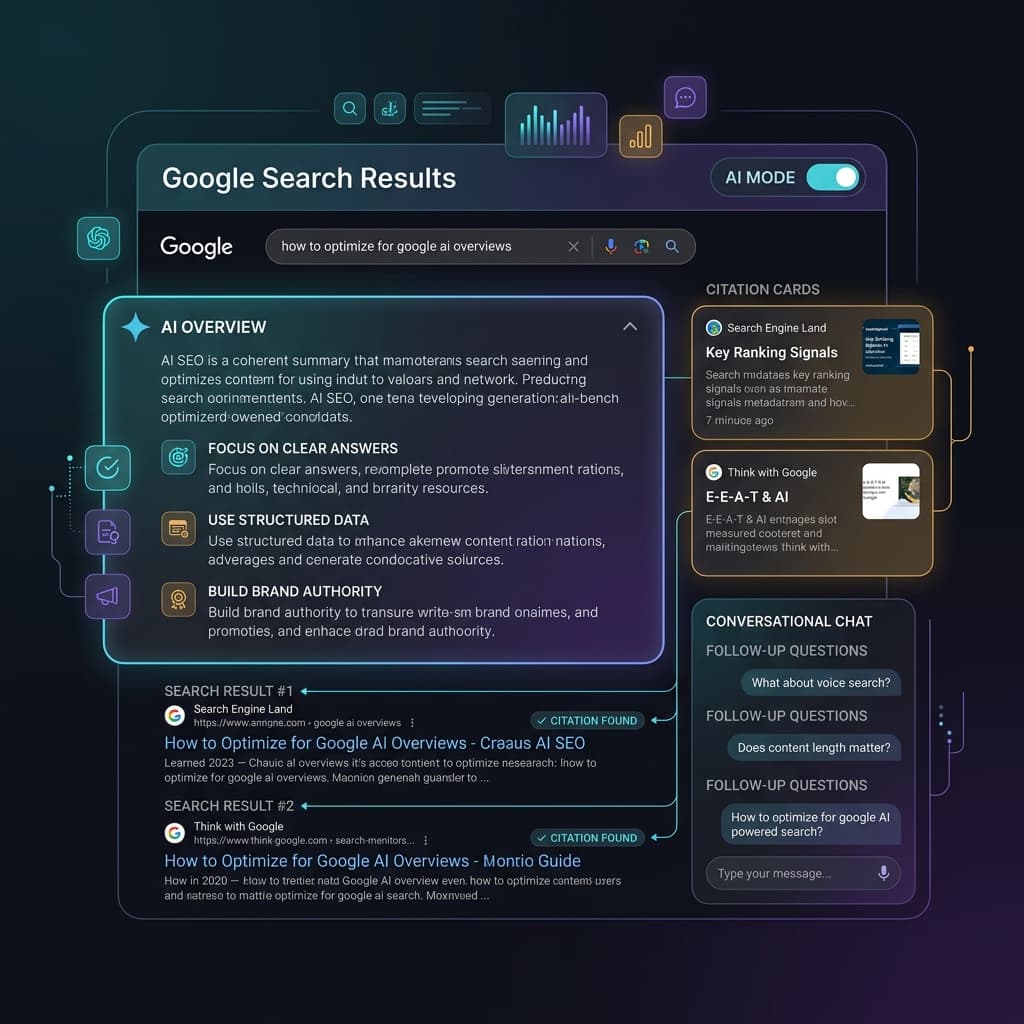
Google AI Overviews and AI Mode SEO: A Practical Visibility Framework (2026)
An in-depth guide to achieving high visibility in Google AI Overviews and AI Mode conversational search. Learn the RAG pipeline, key ranking factors, E-E-A-T requirements, and structured data optimization.

Measuring Content Marketing ROI: Metrics That Matter
Learn how to measure content marketing ROI with the right metrics, attribution models, and reporting frameworks that connect content to revenue.

Thought Leadership Content That Builds Authority and Trust
Create thought leadership content that establishes your brand as an authority, builds trust with your audience, and differentiates you from competitors.
Advertisement