User Intent Content Optimization: Matching Search Queries With Solutions
Optimize content for user intent by understanding the four types of search intent and creating content that precisely matches what searchers are looking for.
Advertisement
Key Takeaways
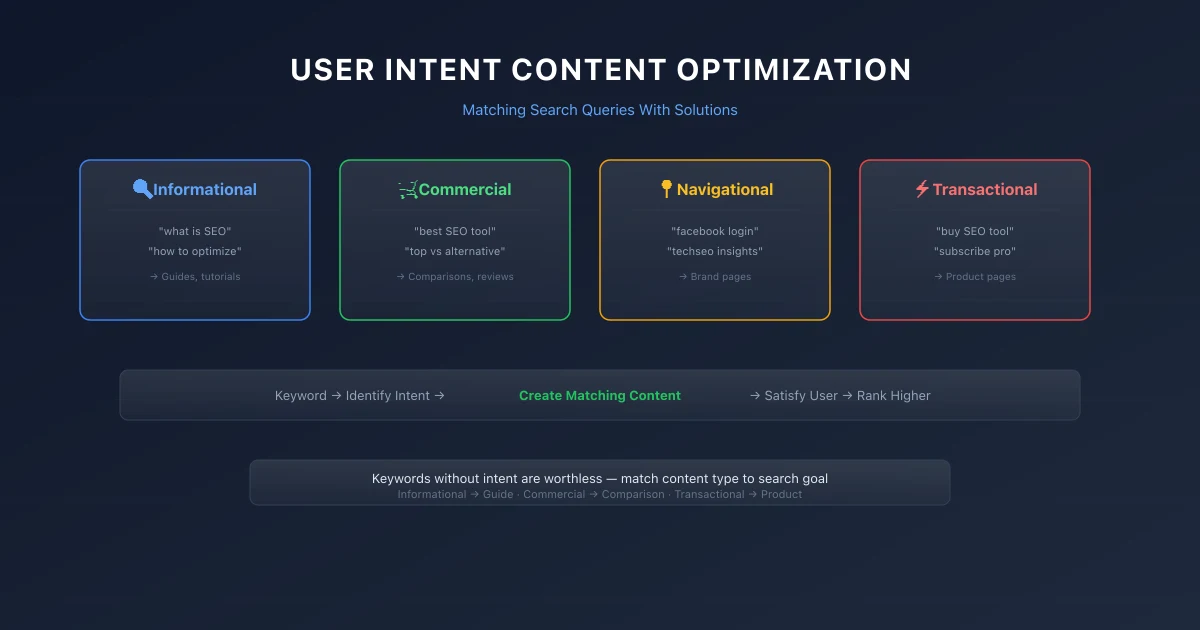
- Search intent falls into four categories: informational, navigational, commercial, and transactional
- Matching content to intent is more important than keyword targeting
- Analyze SERP features to determine the dominant intent for any query
- Each intent type requires a different content format and approach
- Optimizing for intent improves both rankings and conversion rates
- User intent can shift over time and varies by market segment
Keywords without intent are worthless. Two people can search for the same keyword and want completely different things. One person searching for content marketing wants a definition. Another wants a service provider. If your content serves the wrong intent, it will not rank, and it will not convert.
User intent optimization is the process of understanding what searchers actually want and creating content that precisely matches that need. It is the most important concept in modern SEO.
The Four Types of Search Intent
Informational Intent
Informational searches seek knowledge. The searcher wants to learn something. They are not looking to buy. They want an answer to a question, an explanation of a concept, or instructions for a task.
Examples include what is content marketing, how to write a blog post, and why SEO matters. These searches often include question words like what, how, why, and when.
Content for informational intent should educate. Blog posts, guides, tutorials, and explainer videos match this intent. The content should be comprehensive and authoritative. It should answer the question thoroughly and provide value without pushing a sale.
Navigational Intent
Navigational searches target a specific website or page. The searcher already knows where they want to go. They are using the search engine as a navigation tool.
Examples include Facebook login, Google Analytics dashboard, and Ahrefs blog. These searchers are not looking for information. They want to reach a specific destination.
Content for navigational intent is about making sure your site appears for brand searches. Optimize your website for your brand name. Ensure your social media profiles rank for relevant navigational queries.
Commercial Intent
Commercial searches indicate research before a purchase. The searcher is considering a purchase and gathering information to make a decision. They are comparing options and evaluating alternatives.
Examples include best SEO tools, content marketing platform comparison, and Ahrefs vs SEMrush. These searchers are close to a decision but not ready to buy yet.
Content for commercial intent should help with evaluation. Comparison guides, reviews, feature breakdowns, and case studies match this intent. The content should present options fairly while positioning your solution favorably.
Transactional Intent
Transactional searches indicate readiness to take action. The searcher wants to buy, sign up, or download. They are at the bottom of the funnel.
Examples include buy SEO software, subscribe to marketing tool, and download content marketing template.
Content for transactional intent should facilitate the action. Product pages, pricing pages, signup forms, and checkout pages match this intent. The content should reduce friction and make it easy to complete the desired action.
How to Determine Search Intent
Analyze the SERP
The search results page tells you what Google thinks searchers want for any query. Look at the top-ranking pages. What format are they using? Are they blog posts, product pages, or category pages?
If all top results are blog posts, the dominant intent is informational. If top results include product pages and comparison guides, the dominant intent is commercial. If shopping ads appear, there is transactional intent.
Look at SERP Features
SERP features provide additional intent signals. Featured snippets indicate informational intent. Product carousels indicate transactional intent. Local packs indicate local intent with potential commercial or transactional intent.
A query with a featured snippet, People Also Ask boxes, and blog post results is clearly informational. A query with shopping ads and product comparison results is commercial or transactional.
Consider the User Journey
Think about where this query fits in the user journey. A query for what is content marketing is early stage informational. A query for best content marketing platform is mid-stage commercial. A query for content marketing platform pricing is late-stage transactional.
Match your content to the stage where your target audience is most likely to convert. For an early stage query, provide education and build trust. For a late stage query, provide comparison information and clear calls to action.
Optimizing Content for Each Intent Type
Informational Content Optimization
Structure informational content to answer the searcher question completely. Use a question-based heading structure. Include definitions, explanations, examples, and step-by-step instructions.
Format for readability with short paragraphs, bullet points, and clear headings. Include a table of contents for longer guides. Add internal links to related informational content.
Keep informational content ungated. The goal is maximum reach and trust building. You can capture leads through content upgrades within the page.
Commercial Content Optimization
Structure commercial content to help with evaluation. Include feature comparisons, pricing information, pros and cons, and user reviews.
Use a balanced approach that builds trust. Acknowledge limitations of your solution while highlighting strengths. Include real data and specific examples. Testimonials and case studies are powerful in commercial content.
Include clear calls to action that move users to the next stage. Free trials, demos, and consultations are appropriate next steps for commercial intent.
Transactional Content Optimization
Structure transactional content to facilitate action. Make the desired action obvious and easy to complete. Reduce form fields. Remove distractions. Build trust through security badges, guarantees, and testimonials.
Focus on clarity and simplicity. The user knows what they want. Do not make them work to find the buy button or signup form.
Intent Optimization Examples
Example: Content Marketing Strategy
Searching content marketing strategy has informational intent. The searcher wants to learn how to build a content strategy. The top results are comprehensive guides and framework articles.
Content optimized for this intent would be a detailed guide covering strategy components, steps to build a strategy, and examples of effective strategies. It would not include pricing or product comparisons. Those belong on pages targeting commercial intent.
Example: Best Content Marketing Software
Searching best content marketing software has commercial intent. The searcher wants to compare options before making a purchase decision. The top results include comparison articles, review sites, and vendor feature pages.
Content optimized for this intent would compare multiple tools, discuss features and pricing, and provide guidance on choosing the right tool. It would include affiliate links or trial signup calls to action.
For more on understanding your audience, see our guide on how to create SEO-friendly content that readers love. And for using data to optimize content performance, see our guide on data-driven content optimization.
Search Intent Classification Table
| Intent Type | User Goal | Content Optimization Strategy |
|---|---|---|
| Informational | Learn about a topic | Pillar page, structured guides, definitions |
| Navigational | Find a specific site/brand | Brand names, login links, store locator |
| Commercial | Research before buying | Comparison tables, reviews, roundups |
| Transactional | Make a purchase | Product pages, direct order forms |
Common Mistakes
- →Targeting Search Volume Over Intent: Creating high-volume informational pieces when the query has a commercial purchase intent leads to zero conversions.
- →Failing to Track Engagement Metrics: Focusing purely on organic sessions while ignoring average engagement time can hide the fact that content is thin or unhelpful.
- →Ignoring Content Decay: Publishing new posts while letting older, high-ranking pages decay without refreshes leads to a drop in overall domain visibility.
- →Publishing AI content without human editing: Raw AI output lacks personal experience and original expert points, violating search guidelines.
When This Does Not Apply
- →Breaking News Media: Real-time reporting blogs prioritizing publishing velocity do not need deep topic clusters, complex metadata, or historical updates.
- →Internal Strategy & Client Reporting: Confidential data analysis presentations or internal dashboard reports do not require public-facing metadata, indexing, or Schema markups.
Official References
Advertisement
Frequently Asked Questions
Can one page target multiple intents?
Usually not. Each page should target one primary intent. Mixing intents confuses both readers and search engines. Create separate pages for different intents and link between them.
How do I know if my content matches intent?
Check your analytics. High bounce rates and low time on page for a specific query indicate intent mismatch. Users are arriving and leaving because the content does not match what they expected.
Does intent optimization help with conversions?
Yes. Matching content to intent improves conversion rates because users find what they expected. Informational content that tries to sell too early frustrates users and reduces trust.
How often should I review intent alignment?
Review intent alignment quarterly. Search intent can shift as markets evolve and user behavior changes. A query that was informational last year may have shifted to commercial.
What if multiple intents exist for the same keyword?
Create separate content for each intent. One page targeting informational intent and another targeting commercial intent for the same keyword can both rank if they serve different user needs at different stages.

Content Marketing Strategist & SEO Writer
Hannah Blake is a Content Marketing Strategist with 7+ years of experience driving organic growth for SaaS and e-commerce brands. She combines journalistic storytelling with data-driven SEO to create content that ranks, converts, and builds authority. Hannah has developed content strategies that generated over 2 million organic sessions annually for B2B technology companies, and her writing has been featured in Forbes, Entrepreneur, and Search Engine Journal. She specializes in topic cluster modeling, search intent analysis, content gap analysis, and conversion-focused content optimization. Hannah holds a degree in Journalism from the University of Cambridge and is certified in Google Analytics 4 and HubSpot Content Marketing. She regularly teaches workshops on content strategy and SEO writing for emerging marketers.
Comments are temporarily unavailable.
Stay Updated
Get the latest articles and SEO insights delivered to your inbox.
No spam. Unsubscribe anytime.
Related Articles
Google AI Overviews and AI Mode SEO: A Practical Visibility Framework (2026)
An in-depth guide to achieving high visibility in Google AI Overviews and AI Mode conversational search. Learn the RAG pipeline, key ranking factors, E-E-A-T requirements, and structured data optimization.

AI SEO Content Writing: Guide to Quality & Google E-E-A-T (2026)
How to use AI content writing tools (ChatGPT, Claude) for SEO without violating Google Helpful Content guidelines or losing E-E-A-T trust factors.

Measuring Content Marketing ROI: Metrics That Matter
Learn how to measure content marketing ROI with the right metrics, attribution models, and reporting frameworks that connect content to revenue.
Advertisement