Topic Clusters and Pillar Pages: The SEO Architecture Your Content Needs
Build a topic cluster content architecture with pillar pages and supporting articles to establish topical authority and improve search rankings across your entire site.
Advertisement
Key Takeaways
- Topic clusters organize content around pillar pages that cover broad topics comprehensively
- Internal linking between pillar and cluster pages signals topical authority to search engines
- Pillar pages should be the most comprehensive resource on your site for that topic
- Cluster pages target specific subtopics and link back to the pillar page
- This architecture improves rankings for both pillar and cluster pages through relevance signals
- Implementing topic clusters can increase organic traffic by 30 to 50 percent within six months
The old approach to blogging is dead. Publishing random articles about random topics and hoping some of them rank no longer works. Google has gotten better at understanding which sites have genuine expertise on a subject and which sites just have a collection of loosely related posts.
Topic clusters and pillar pages solve this problem. They organize your content around core topics, signal expertise to search engines, and create a structure that benefits every page in the cluster.
What Are Topic Clusters
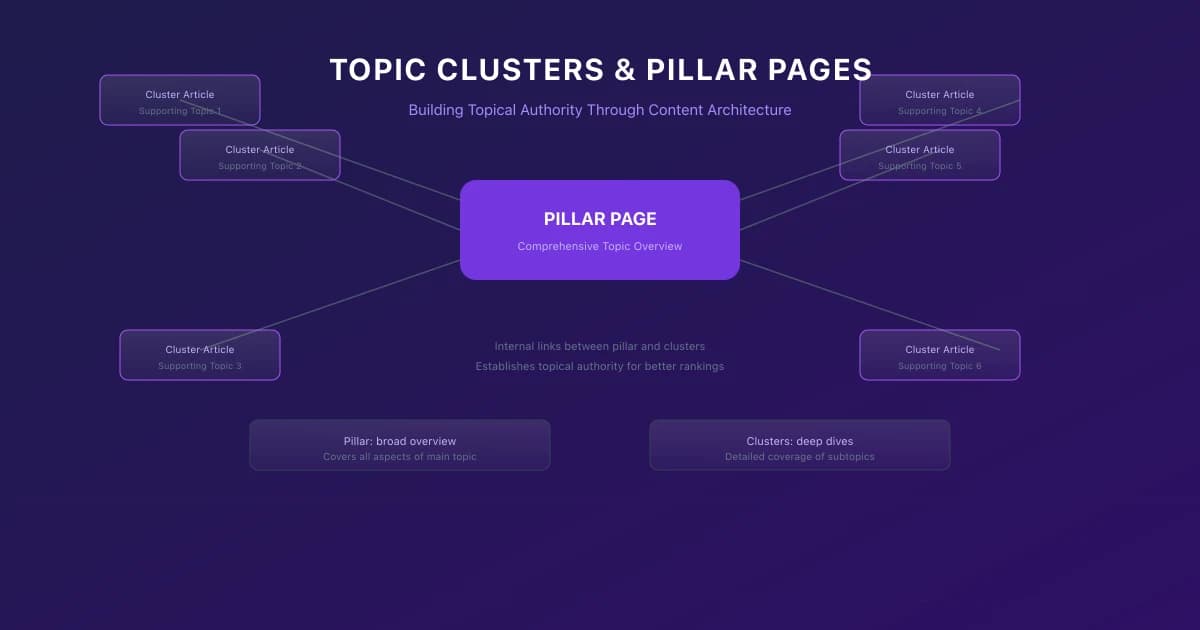
A topic cluster consists of one pillar page and multiple cluster content pages. The pillar page covers a broad topic comprehensively. The cluster pages cover specific subtopics in depth. Every cluster page links to the pillar page, and the pillar page links to all cluster pages.
This structure tells Google that your site is a comprehensive resource on that topic. When you have a pillar page that covers everything about keyword research and ten supporting articles that cover individual aspects, Google understands you have real expertise in that area.
The Pillar Page
A pillar page is a comprehensive guide to a broad topic. It covers the topic at a high level and links to detailed cluster pages for each subtopic. Pillar pages are typically 3000 to 5000 words and include internal links to every cluster page.
A good pillar page is structured as a resource hub. It starts with a broad overview and then organizes subtopics into sections. Each section introduces the concept and links to the detailed cluster page for that specific subtopic.
Cluster Content
Cluster pages are detailed articles about specific subtopics related to the pillar topic. They cover one narrow aspect in depth. Each cluster page links back to the pillar page using relevant anchor text.
For a pillar page about content marketing, cluster pages might cover content repurposing, editorial calendar management, content distribution, and content marketing ROI. Each of these is a focused article that supports the broader pillar topic.
Why Topic Clusters Improve SEO
Topic clusters improve SEO through several mechanisms that work together.
Topical Authority
Google evaluates site-wide expertise on topics. A site with 50 articles about content marketing demonstrates more authority than a site with one article about content marketing and 49 articles about unrelated topics.
Topic clusters concentrate your content investment into specific areas. Instead of spreading your efforts across many unrelated topics, you build deep expertise in the topics that matter to your business.
Internal Link Structure
The internal linking pattern of topic clusters distributes authority throughout the cluster. The pillar page accumulates links from all cluster pages, which strengthens its authority. The cluster pages benefit from links within the pillar page, which passes authority back to them.
This reciprocal linking pattern is more effective than the traditional hub-and-spoke model where all links flow outward from a central page.
Semantic Relevance
When Google sees consistent internal linking between pages on related topics, it understands the semantic relationship between those pages. This improves the search engine understanding of what each page is about and how they relate to each other.
Improved Click-Through Rates
Pillar pages often rank for broad terms and serve as entry points. When a user lands on your pillar page, they see links to relevant cluster content. This increases page views per session and time on site. Both signals can positively influence rankings.
Building Your Topic Cluster Architecture
Step 1: Identify Core Topics
Start with the topics that are most important to your business. These should be topics where you want to be recognized as an authority. Limit your core topics to three to five to maintain focus.
Each core topic should have enough search volume to justify the investment and enough subtopics to create meaningful cluster content.
Step 2: Create the Pillar Page
Write a comprehensive guide that covers the broad topic thoroughly. Structure it as a resource hub with clear sections for each subtopic. Include links to existing cluster content where it exists, and plan for links to future cluster content.
The pillar page should be the most complete resource on your site for that topic. It does not need to cover every detail, but it should at least mention every significant subtopic and link to the detailed cluster page.
Step 3: Build Cluster Content
Create detailed articles for each subtopic. Each cluster page should focus on one specific aspect of the broader topic. Write for the specific keyword intent of that subtopic rather than trying to cover the entire topic in one article.
Step 4: Implement the Linking Structure
Every cluster page needs a link back to the pillar page using descriptive anchor text. The pillar page needs links to every cluster page in the appropriate section.
Use natural anchor text that describes the linked content. The link from the pillar page to a cluster page about content repurposing should say something like learn more about our content repurposing strategy rather than click here.
Measuring Topic Cluster Success
Track rankings for your pillar page target keywords. Monitor the indexed status of all cluster pages. Measure organic traffic growth to the entire cluster over time. Look at internal link flow using crawling tools to ensure every page is connected.
A successful topic cluster implementation shows consistent ranking improvements across the cluster over three to six months. Individual cluster pages may rank faster because they target more specific keywords.
For more on foundational content strategy, see our guide on building a data-driven content marketing strategy framework. And for writing effective cluster content, see our guide on how to create SEO-friendly content that readers love.
High-Quality Content Optimization Checklist
- Verify Search Intent: Match content structure to target query type.
- E-E-A-T Assessment: Include original insights, author credentials, and fact-checked claims.
- Structured Heading Hierarchy: Use one H1, followed by H2 and H3 subsections.
- Anchor Text Relevance: Use descriptive, target-focused anchor text for internal links.
- Mobile Parity Check: Verify that mobile viewports render all key paragraphs and embeds.
Common Mistakes
- →Targeting Search Volume Over Intent: Creating high-volume informational pieces when the query has a commercial purchase intent leads to zero conversions.
- →Failing to Track Engagement Metrics: Focusing purely on organic sessions while ignoring average engagement time can hide the fact that content is thin or unhelpful.
- →Ignoring Content Decay: Publishing new posts while letting older, high-ranking pages decay without refreshes leads to a drop in overall domain visibility.
- →Publishing AI content without human editing: Raw AI output lacks personal experience and original expert points, violating search guidelines.
When This Does Not Apply
- →Breaking News Media: Real-time reporting blogs prioritizing publishing velocity do not need deep topic clusters, complex metadata, or historical updates.
- →Internal Strategy & Client Reporting: Confidential data analysis presentations or internal dashboard reports do not require public-facing metadata, indexing, or Schema markups.
Official References
Advertisement
Frequently Asked Questions
How many cluster pages do I need per pillar?
Start with five to ten cluster pages per pillar. Quality matters more than quantity. Each cluster page should cover a legitimate subtopic that deserves its own article.
Can I turn an existing article into a pillar page?
Yes. If you have a comprehensive article that covers a broad topic, you can expand it into a pillar page by adding sections for subtopics and linking to cluster content.
Should pillar pages be paginated?
No. Pillar pages work [best](/blog/nextjs-seo-best-practices) as single, comprehensive pages. Pagination breaks the user experience and dilutes the authority signal. Keep all pillar content on one URL.
How often should I update pillar pages?
Review pillar pages quarterly. Add new cluster pages as you create them. Update statistics and examples. Pillar pages should always be current because they represent your authority on the topic.
Do topic clusters work for small sites?
Yes. Even a site with 20 articles can benefit from topic clustering. Organize existing content into clusters and fill gaps with new content over time.

Content Marketing Strategist & SEO Writer
Hannah Blake is a Content Marketing Strategist with 7+ years of experience driving organic growth for SaaS and e-commerce brands. She combines journalistic storytelling with data-driven SEO to create content that ranks, converts, and builds authority. Hannah has developed content strategies that generated over 2 million organic sessions annually for B2B technology companies, and her writing has been featured in Forbes, Entrepreneur, and Search Engine Journal. She specializes in topic cluster modeling, search intent analysis, content gap analysis, and conversion-focused content optimization. Hannah holds a degree in Journalism from the University of Cambridge and is certified in Google Analytics 4 and HubSpot Content Marketing. She regularly teaches workshops on content strategy and SEO writing for emerging marketers.
Comments are temporarily unavailable.
Stay Updated
Get the latest articles and SEO insights delivered to your inbox.
No spam. Unsubscribe anytime.
Related Articles
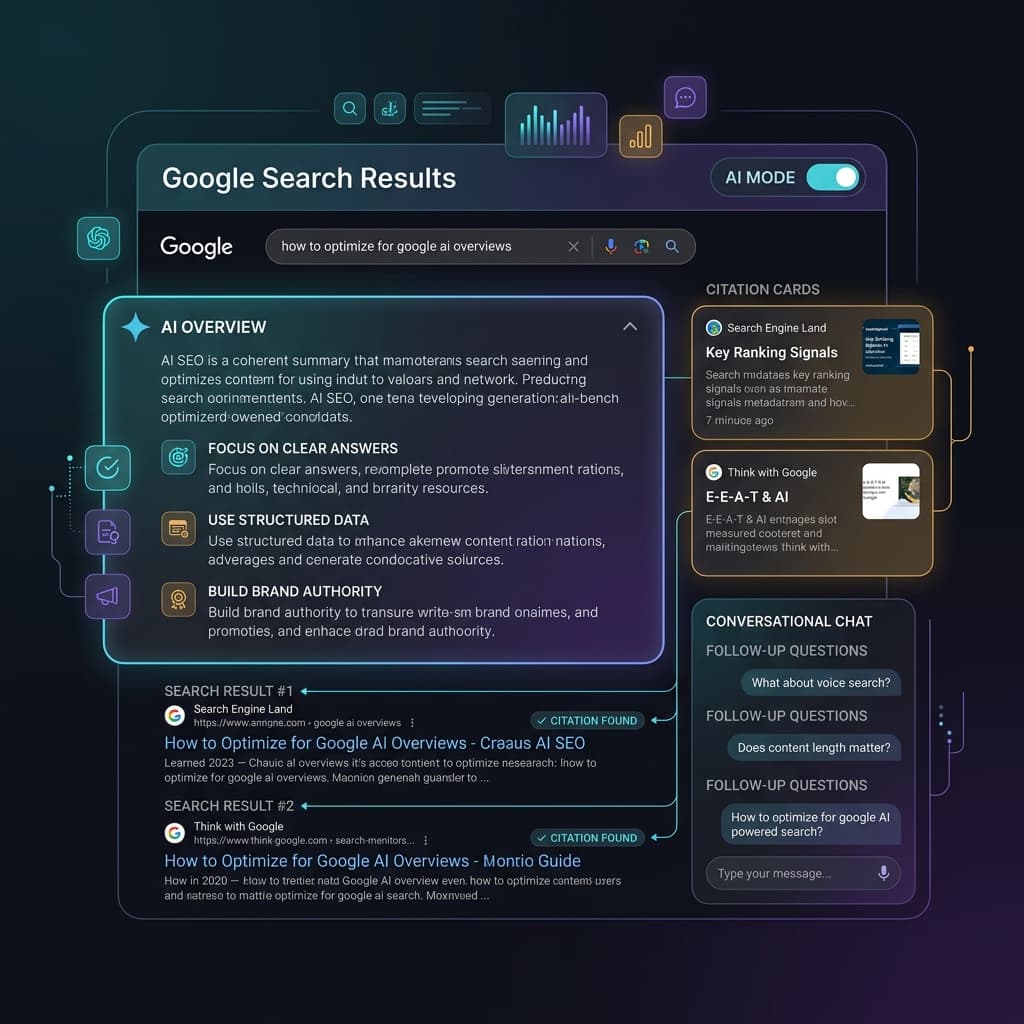
Google AI Overviews and AI Mode SEO: A Practical Visibility Framework (2026)
An in-depth guide to achieving high visibility in Google AI Overviews and AI Mode conversational search. Learn the RAG pipeline, key ranking factors, E-E-A-T requirements, and structured data optimization.

AI SEO Content Writing: Guide to Quality & Google E-E-A-T (2026)
How to use AI content writing tools (ChatGPT, Claude) for SEO without violating Google Helpful Content guidelines or losing E-E-A-T trust factors.

Measuring Content Marketing ROI: Metrics That Matter
Learn how to measure content marketing ROI with the right metrics, attribution models, and reporting frameworks that connect content to revenue.
Advertisement