The Future of Content Marketing: What Actually Works After AI Search (2026 Guide)
Discover the state of content marketing in 2026. Learn how AI-powered search engines shift user behavior and how to win with GEO, E-E-A-T, and multi-channel strategies.
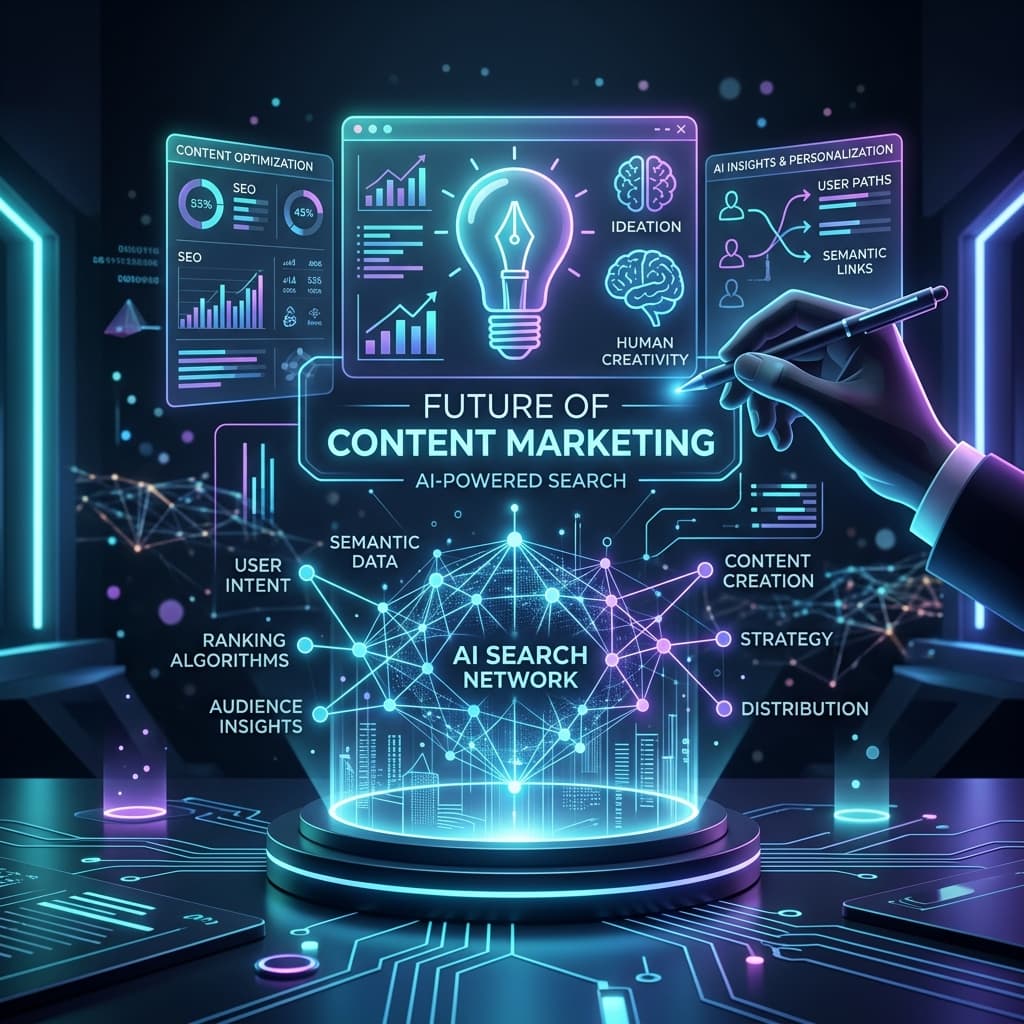
Key Takeaways
- AI-powered search engines and answer engines (like SearchGPT, Perplexity, and Google AI Overviews) are driving zero-click searches, reducing standard CTR.
- Successful content marketing in 2026 requires transitioning from keyword-stuffed volume to high-information-gain assets (original research and SME quotes).
- Generative Engine Optimization (GEO) has become a core SEO skill, relying on statistics, authoritative citations, and technical structured schema markup.
- Diversification away from single-source search traffic to owned platforms (email lists, private communities) is critical for brand survival.
The promise of early digital marketing was built on a predictable click-through model: a user types a query, search engines serve ten blue links, and the user visits the most relevant page. Today, in 2026, that model is undergoing its most radical transformation since the birth of the web.
With the widespread integration of Large Language Models (LLMs) into the core search experience, query discovery is shifting from a cataloging directory to an active dialogue. Users are no longer looking for lists of websites; they want immediate, contextualized, and fully synthesised answers.
This guide provides a comprehensive framework for founders, marketing executives, and SEO experts. It unpacks the mechanics of AI-driven search, analyzes what actually works in content marketing today, and outlines the step-by-step strategies you need to implement to build a future-proof, highly authoritative digital footprint.
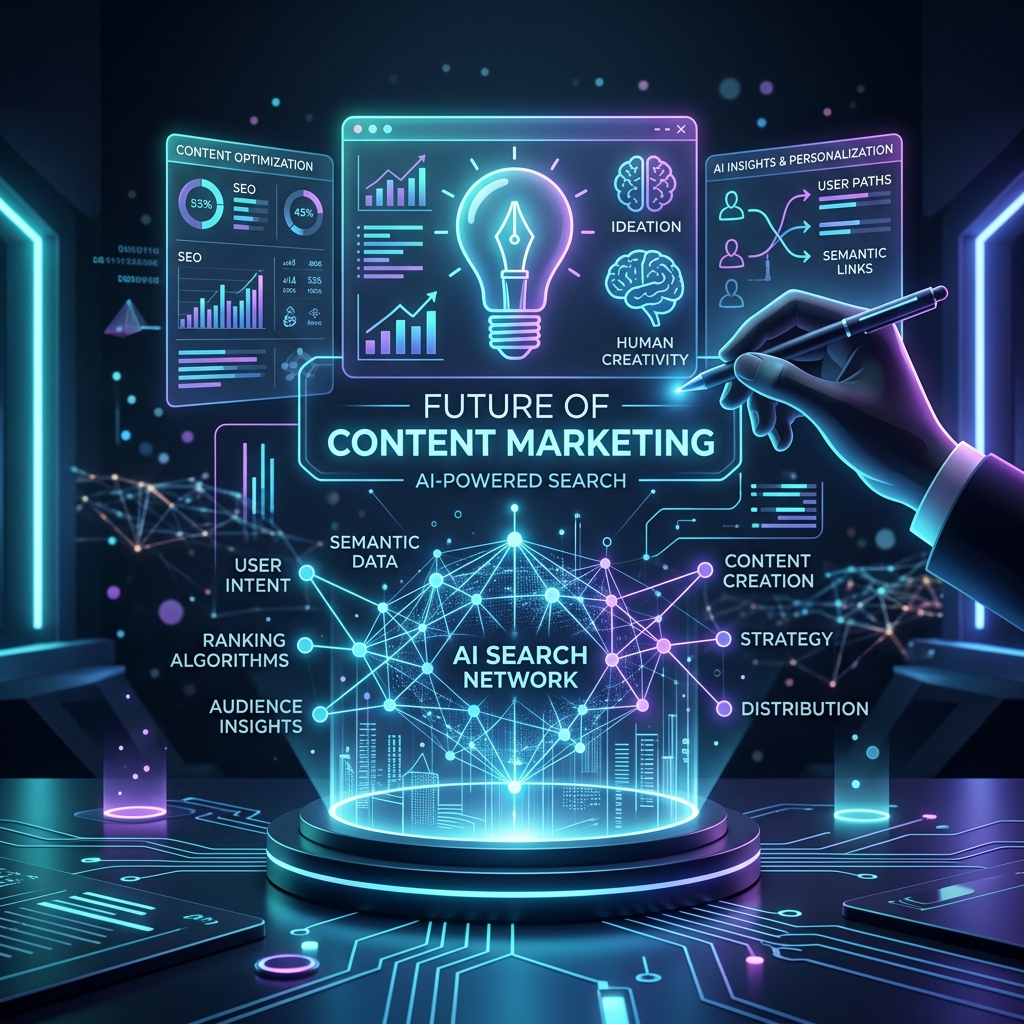
1. Introduction: The AI Search Shift
In 2026, the search box is no longer a simple keyword filter. The rise of "answer engines" and conversational interfaces—led by Google's AI Overviews, OpenAI's SearchGPT, Gemini, and Perplexity—has fundamentally altered content discovery.
Instead of routing traffic to websites, search engines have become synthesis engines. They ingest the web, summarize information, and present it directly to the user.
For content marketers, this shift has led to a dramatic rise in zero-click searches. Gartner estimates that traditional search engine traffic will fall by 25% by the end of 2026. When a user can read a detailed explanation of a technical concept, compare product prices, or get step-by-step coding instructions without leaving the search results page, the traditional traffic pipeline dries up.
To learn more about how search engines handle these conversational interfaces, read our deep dive into Google AI Overviews.
However, this is not the death of content marketing. It is a transition. While informational query traffic is declining, the value of high-intent, brand-specific search remains intact. Furthermore, AI engines require high-quality source material to synthesize answers.
The brands that survive are those that shift their focus from catching low-intent pageviews to becoming the authoritative sources that train and feed these LLM models.
2. Why Traditional Content Marketing Is Changing
For over a decade, the standard playbook for organic traffic growth was the "skyscraper technique." Brands would identify a target keyword, analyze the top 10 ranking pages, compile their structures, write a longer (often bloated) version, and build backlinks.
In the era of generative AI, this playbook has collapsed.
The barrier to entry for written content has fallen to zero. Anyone can prompt an LLM to generate a 3,000-word article on any topic in seconds. The result is a saturated web filled with repetitive, low-value text.
Search engines have responded with advanced algorithms designed to weed out this duplicate noise. They evaluate Information Gain—a metric that measures the volume of new, unique insights a page offers compared to what is already indexed.
If your content simply rehashes what is already available, search engines will filter it out, rendering it invisible. This makes raw, unedited AI output a major business liability.
To explore this dynamic in detail, refer to our analysis on AI Content Marketing Limits.
3. How AI Search Changes Content Discovery
To optimize for modern search platforms, we must first understand how they retrieve information. Traditional search engines rely on keyword mapping, indexing, and PageRank backlinks. AI search engines use a combination of semantic search, vector embeddings, and Retrieval-Augmented Generation (RAG).
[User Query]
     │
     ▼
[Semantic Matching / Vector Search] ──► [Retrieves Relevant Web Fragments]
     │
     ▼
[LLM Synthesis & Citation] ──► [Generates Answer with Inline Source Links]
     │
     ▼
[User Interface (AI Overview / Answer Card)]
When a user submits a natural language query, the system converts it into a vector representation and searches its database for semantically similar concepts. It retrieves fragments of relevant web pages and passes them to an LLM, which synthesizes a clean, direct response, complete with inline citations.
| Architectural Feature | Traditional Google Search | AI-Powered Answer Engines |
|---|---|---|
| Retrieval Basis | Exact keyword match & links | Semantic relationships & concepts |
| User Experience | List of links to click | Direct synthesized text answers |
| Primary CTR Driver | Title tag and Meta description | Direct inline citation source links |
| Indexing Speed | Hours to days via standard crawl | Real-time indexing via APIs and RAG |
| Helpfulness Criteria | High domain rating, basic answers | High information gain, expert data |
For a complete framework on aligning your text with searcher expectations, see our guide on User Intent Content Optimization.
4. What Still Works in Content Marketing After AI Search
If generic compilations are dead, what works? The answer lies in creating content that AI models cannot simulate.
You must focus on assets that require human experience, access to proprietary systems, and personal connections.
Original Research
AI engines can compile data, but they cannot conduct experiments, run surveys, or generate new datasets. Publishing original, data-driven studies remains the most powerful strategy in content marketing.For example, Orbit Media's annual blogging survey and Backlinko's search engine CTR analyses are cited thousands of times by other websites—and, crucially, by AI search engines looking for factual evidence.
First-Hand Experience
Experience is the "E" in Google's E-E-A-T framework. AI models do not have hands-on experience; they have never configured a server, managed a database, or debugged a Next.js application.Writing in the first person, sharing real failure logs, and showing raw screenshots of your processes build immediate trust with readers and search crawlers alike.
Expert Insights
If your team lacks specific expertise on a topic, do not let AI make it up. Interview industry experts, customers, or internal developers.Featuring direct quotes, audio transcripts, or video embeds adds unique perspectives that distinguish your content from generic search engine results.
Brand Authority
When a customer searches for your brand name directly (e.g., "Seotech audit tools"), AI engines must display your site.Building a recognizable brand that users seek out directly is your strongest shield against search algorithm volatility. Authority is built over time through consistent thought leadership.
Community Building
Rather than relying solely on third-party search engines, build direct communication channels with your audience.Host Slack channels, Discord servers, subreddits, or forums. A highly engaged community acts as a source of feedback, referral traffic, and brand loyalty.
Email Ownership
Your email list is an owned asset. Unlike organic search, you do not need to pay a platform or optimize for an algorithm to reach your subscribers.Treat your newsletter as a primary product, not an afterthought.
Video Content
As search queries become multi-modal, indexing video content has become standard.Embedding short, clear video demonstrations alongside your written guides helps capture visual search traffic on platforms like YouTube and Google Video search.
Multi-Channel Distribution
Do not publish an article and wait for search engine crawlers to find it. An effective content distribution strategy repurposes a single pillar piece into multiple formats:- →An email newsletter snippet.
- →A PDF checklist shared on LinkedIn.
- →A short-form video script for social channels.
- →An interactive calculator tool.
5. The Rise of Generative Engine Optimization (GEO)
As AI search engines replace traditional search result layouts, a new optimization discipline has emerged: Generative Engine Optimization (GEO).
Academic research, including a landmark study by researchers at Princeton and Georgia Tech, has identified several techniques that significantly improve a website's likelihood of being cited by LLMs.
The Princeton/Georgia Tech GEO Optimization Framework
                       ┌──────────────────────────┐
                       │   GEO Optimization Core  │
                       └─────────────┬────────────┘
                                     │
             ┌───────────────────────┼───────────────────────┐
             ▼                       ▼                       ▼
   ┌──────────────────┐    ┌──────────────────┐    ┌──────────────────┐
   │ Citations & Data │    │   Format Ease    │    │ Entity Alignment │
   │                  │    │                  │    │                  │
   │  * High-trust URLs │    │  * Direct lists  │    │  * Schema markup │
   │  * Stats & metrics│    │  * Definition tags│    │  * Clear context │
└──────────────────┘ └──────────────────┘ └──────────────────┘- Cite Authoritative Sources: LLMs are designed to mitigate hallucinations by cross-referencing information. When you include high-quality outbound links to verified, authoritative studies, search models view your content as a reliable node in the topical graph.
- Include Quantitative Evidence: AI models prefer concrete numbers. Instead of writing "our platform makes API calls fast," write "our API response times average 45ms under a load of 10,000 concurrent requests."
- Format for Extraction: Use structured lists, clear definition tags, and clean HTML tables. If an LLM can easily parse your data structure, it is far more likely to extract it as a direct answer.
- Build Clear Entity Associations: Ensure your brand name, core products, and founders are linked using structured JSON-LD schemas. This helps search models understand your relationship to specific target keywords.
6. EEAT and Trust Signals in 2026
Google's Quality Rater Guidelines place heavy emphasis on E-E-A-T: Experience, Expertise, Authoritativeness, and Trustworthiness. In 2026, these are no longer just editorial guidelines; they are core algorithmic ranking signals.
To verify your authority, search crawlers look for trust signals both on and off your page:
- →Verified Author Entities: Every article must feature a real author bio with links to their professional social profiles, portfolio sites, and other publications.
- →Organization Schemas: Implement detailed structured data to define your business, founders, and target categories.
- →Factual Accuracy: Search engines cross-reference your statements against established databases. Publishing incorrect facts or unchecked AI hallucinations will quickly degrade your site's authority.
ProfilePage schema in JSON-LD format to verify author expertise:
{
  "@context": "https://schema.org",
  "@type": "ProfilePage",
  "mainEntity": {
    "@type": "Person",
    "name": "Mehul Makavana",
    "jobTitle": "Founder & Editor, TechSEO Insights",
    "worksFor": {
      "@type": "Organization",
      "name": "TechSEO Insights",
      "url": "https://www.seotech.app"
    },
    "knowsAbout": [
      "Technical SEO",
      "Web Performance",
      "Generative Engine Optimization"
    ],
    "sameAs": [
      "https://www.linkedin.com/in/mehul-makavana",
      "https://twitter.com/mehul_makavana"
    ]
  }
}
By adding these explicit signals, you help AI search engines connect your brand to your area of expertise.
For more actionable tips on drafting content that meets these rigorous standards, see our guide on How to Use AI for SEO Content Writing.
7. Content Formats Winning in AI Search
Different content formats perform differently when processed by search models.
To maximize your visibility, prioritize formats that offer clear, structured, and primary data.
| Content Format | Likelihood of AI Citation | Primary SEO Value | User Engagement Level |
|---|---|---|---|
| Proprietary Data Reports | Extremely High | Earns natural backlinks | High (Referenced by peers) |
| Interactive Calculators | High | Attracts branded searches | Very High (Tool utility) |
| SME Interview Transcripts | High | Unique entity text content | Medium (Deep reading) |
| Step-by-Step Code Guides | Medium-High | High information gain | High (Developer utility) |
| General Definition Pages | Low-Medium | Prone to zero-click summary | Low (Quick exit) |
For instance, an interactive tool like an SEO dashboard dashboard or a page speed calculator has much higher utility than a simple text-based explanation.
To explore building technical layouts that support these formats, read our guide on Next.js SEO Best Practices.
8. Content Marketing Metrics That Matter Beyond Traffic
In the zero-click era, tracking traditional metrics like pageviews and organic sessions can be misleading. A drop in traffic does not necessarily mean your marketing is failing; it may simply mean that users are getting answers in AI Overviews with your brand cited as the source.
To measure success in 2026, content teams must transition to a modern dashboard that tracks:
- Branded Search Volume: The number of users searching specifically for your brand name or products in search engines.
- Email Subscriber Growth: The acquisition rate of direct, owned contact channels.
- Engagement Time & Scroll Depth: Metrics that show whether visitors are actually reading your content or bouncing immediately.
- AI Share of Voice (SoV): How often your brand is cited by models like Gemini, Claude, Perplexity, and SearchGPT for relevant queries.
- Conversion Rate from Referral Traffic: The efficiency of converting high-intent users who click through from AI citations.
9. Building a Future-Proof Content Strategy
To succeed in this new environment, we recommend implementing the Information Gain Content Framework. This is a 5-step process designed to prioritize original insights and structural technical optimization.
The Information Gain Content Framework
- Step 1: Topical Mapping & Entity Auditing: Identify gaps in your current coverage and group related pages into logical clusters. For a detailed playbook on this, refer to our Content Audit Framework.
- Step 2: Subject Matter Expert (SME) Interviews: Interview internal team members or industry authorities before writing. Inject their quotes and insights directly into your drafts.
- Step 3: Multi-modal Asset Creation: Supplement your text with custom diagrams, infographics, tables, and short-form videos to capture visual and multi-modal search traffic.
- Step 4: Technical Schema Implementation: Mark up your pages with Article, ProfilePage, and Product schemas to make your content easy for LLMs to crawl and index.
- Step 5: Multi-channel Repurposing & Distribution: Repurpose your primary pillar content into newsletters, social posts, and PDFs to reach audiences on owned and third-party channels.
To learn more about organizing your pages, read our guide on Topic Clusters and Pillar Pages.
10. Common Mistakes Brands Make
Avoid these common pitfalls to protect your digital visibility:
- →Publishing Raw AI Outputs: Publishing unedited text from LLMs results in low-information-gain content that search engines will quickly deprioritize.
- →Ignoring Brand Authority: Focusing purely on target keywords without building a recognizable brand name leaves you vulnerable to search engine layout changes.
- →Blocking Search Bots: While protecting your intellectual property is important, blocking standard search crawlers in your robots.txt will exclude your brand from AI summaries and overviews.
- →Overlooking Internal Links: Neglecting to link related pages makes it difficult for search engines and AI models to understand your site's structure.
11. The Future of Content Marketing Beyond 2026
As we look past 2026, the integration of search and AI will continue to accelerate. We anticipate the rise of agentic search engines—systems that do not just retrieve information, but actively execute tasks on behalf of the user, such as booking flights, compiling research dossiers, or buying products.
In this environment, content marketing will shift from page-level optimization to data-feed optimization. The brands that win will be those that provide clean, structured API endpoints, real-time data feeds, and highly interactive user interfaces.
To ensure your web applications are ready for this transition, read our guides on React SEO Best Practices and building fast PWA SEO Guides.
12. Implementation Checklist & Summary
- Topical Audit: Identify low-information-gain pages and plan to update, merge, or redirect them.
- SME Plan: Establish an interview process to gather quotes from internal developers or product managers.
- GEO Structure: Add quantitative metrics, structured tables, and outbound citations to all key articles.
- Structured Schemas: Validate your site's JSON-LD schemas using Google's Rich Results Test tool.
- Analytics Setup: Configure GA4 to track custom scroll depth and conversion metrics, as outlined in our Google Analytics 4 Guide.
- Distribution Audit: Build a repurposing workflow to share content across email, social media, and video platforms.
13. Official References
- →Google Search Central - Creating Helpful, Reliable, People-First Content
- →Content Marketing Institute (CMI) - B2B Content Marketing Benchmarks & Trends
- →Princeton University & Georgia Tech - Academic Study on Generative Engine Optimization (GEO)
- →Orbit Media - Annual Blogger Survey and Organic Traffic Statistics
- →Google Search Central - Guidance on AI-Generated Content
14. Conclusion
Winning at content marketing in 2026 is no longer about matching keyword search volume or out-writing competitors by length.
It is about establishing verified brand authority, producing proprietary data, and structuring your technical assets to be easily ingested by both human readers and search engines.
Audit your setup regularly, focus on high-quality content that meets E-E-A-T expectations, and monitor performance indicators closely.
To deepen your understanding of search optimization and measurement strategies, read our companion guides: Content Refresh Strategy, Thought Leadership Content Marketing, and Website Analytics Audit Checklist.
Frequently Asked Questions
What is Generative Engine Optimization (GEO)?
Generative Engine Optimization (GEO) is the process of optimizing content to be cited and recommended by AI-powered search engines and Large Language Models (LLMs) such as Google AI Overviews, SearchGPT, Gemini, and Perplexity. Key strategies include using quantitative data, authoritative citations, clear formatting, and technical schema markup.
How does E-E-A-T help content rank in the age of AI search?
Google and other AI search platforms use classifiers to measure Experience, Expertise, Authoritativeness, and Trustworthiness (E-E-A-T). By including first-hand experiences, screenshots, expert quotes, and validated facts, you satisfy these classifiers, proving that your content offers value that an AI model cannot automatically generate.
Will AI search destroy traditional content marketing?
No, but it is destroying lazy content marketing. Generic, compiled, or unedited AI-written content will struggle to gain organic traffic. However, high-quality content that offers genuine information gain, proprietary research, and unique insights will continue to thrive, particularly as source citations in AI answers.
Which content marketing metrics should we track in 2026?
Instead of just tracking pageviews and organic sessions, focus on brand search volume (users searching specifically for your company), email subscriber growth, scroll depth, engagement rate, share of voice in LLM responses, and direct conversion rate from high-intent referral sources.
How do we get cited as a source in Google AI Overviews and Perplexity?
Ensure your content features clear, direct answers to common questions; include original statistics, graphs, and images with structured schema markup; use clear table formats; and link out to trusted resources while maintaining high topical authority.

Founder & Editor, TechSEO Insights
Mehul Makavana writes practical SEO, AI tools, and web development guides based on hands-on research, testing, and real website optimization work.
Subscribe to TechSEO Insights
Get the latest guides on technical SEO, Core Web Vitals, and content marketing delivered straight to your inbox.
Privacy Note: By subscribing, you agree to receive our newsletter (Lawful Basis: Consent). We retain your email address until you choose to unsubscribe. For more details, view our Privacy Policy.