Marketing Analytics Trends 2026: AI, Attribution & Privacy-First Measurement Explained
Discover the top marketing analytics trends for 2026. Learn how AI, privacy-first measurement, and advanced attribution modeling are transforming how modern businesses track and optimize performance.
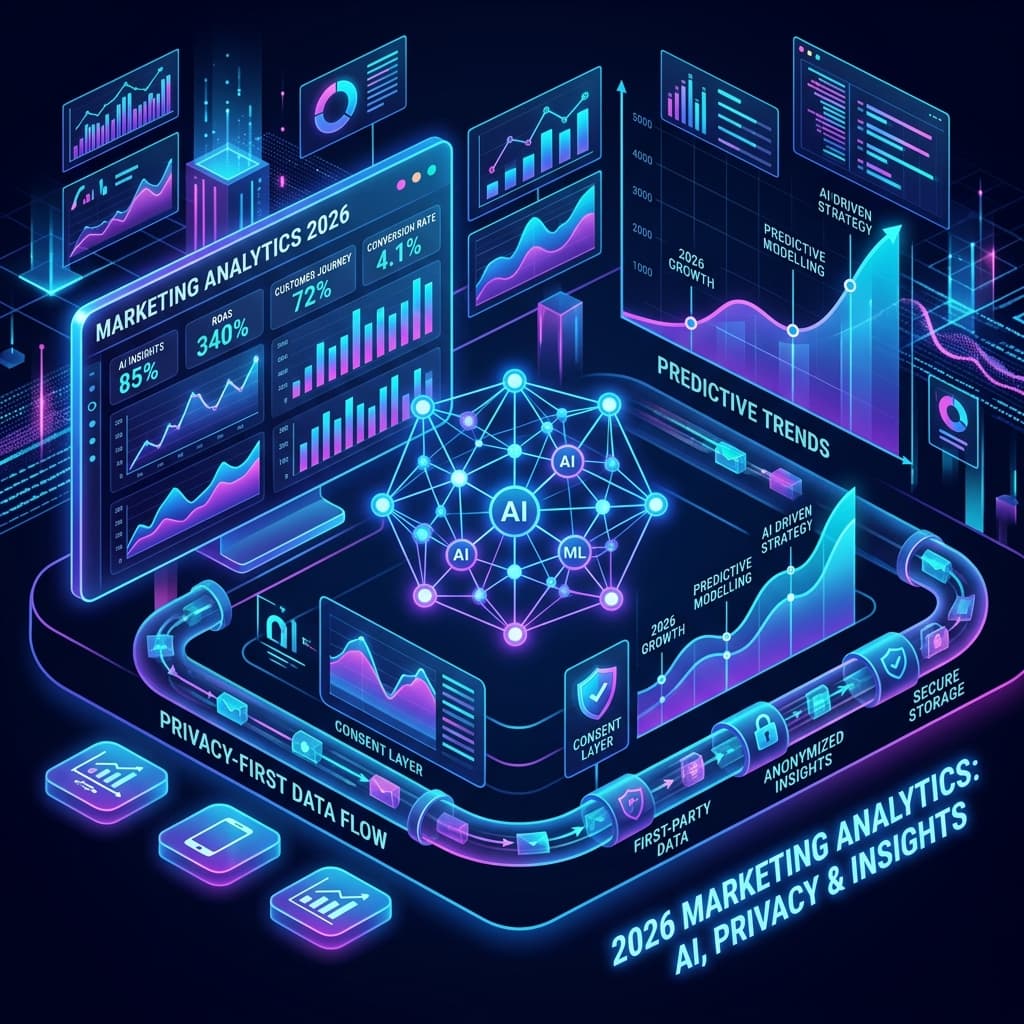
Key Takeaways
- AI-powered marketing analytics has moved from passive reporting to proactive predictive forecasting and automated insights generation.
- Privacy-first measurement and cookieless tracking are now mandatory standards, making Consent Mode and Server-Side tagging essential.
- Traditional last-click attribution is dead; machine learning-driven multi-touch attribution (MTA) provides a holistic view of the customer journey.
- First-party data strategies are critical for bridging the gap left by the deprecation of third-party cookies.
The landscape of digital marketing has undergone a seismic shift. For years, marketers relied on an abundance of granular, user-level data, tracked seamlessly across the web via third-party cookies. Today, that era is definitively over. As we navigate through 2026, the intersection of tightening data privacy regulations, the rapid advancement of artificial intelligence, and the demand for provable Return on Investment (ROI) has completely rewritten the playbook for marketing analytics.
Modern marketing analytics is no longer just about reporting what happened yesterday; it is about predicting what will happen tomorrow. It has evolved from a passive tracking exercise into a dynamic, AI-driven engine that powers real-time business strategy. To succeed in this new environment, marketers, SEO professionals, and founders must embrace a completely new framework for measurement.
In this comprehensive guide, we will break down the most critical marketing analytics trends for 2026, explaining how AI, predictive analytics, advanced attribution modeling, and privacy-first measurement are reshaping how we understand user behavior and optimize campaign performance.
1. Why Marketing Analytics Is Changing in 2026
To understand where marketing analytics is heading, we first need to understand the forces driving the change. The disruption of traditional analytics stems from three primary pillars:
The Regulatory Landscape
Global privacy laws have fundamentally altered data collection. The General Data Protection Regulation (GDPR) in Europe set the standard, but frameworks like the California Privacy Rights Act (CPRA) and the EU’s Digital Markets Act (DMA) have forced global technology platforms to enforce strict user consent requirements. Brands can no longer collect data indiscriminately. Every tracking script and pixel must justify its existence and explicitly seek user permission.The Technological Shift
Major web browsers (Safari, Firefox, and finally, Chrome) have clamped down on cross-site tracking technologies. Apple’s Intelligent Tracking Prevention (ITP) and iOS App Tracking Transparency (ATT) broke the traditional feedback loop for advertising platforms. This "signal loss" means that default out-of-the-box tracking scripts capture far less data than they did five years ago.The AI Revolution
While privacy laws restricted data collection, machine learning and Generative AI matured rapidly. This created a paradox: marketers have access to fewer explicit data points, but possess vastly superior tools for interpolating data, filling in gaps, and predicting outcomes.The combination of these factors has birthed a new paradigm: Privacy-First Analytics powered by AI.
2. AI-Powered Analytics: From Reporting to Action
One of the most profound marketing analytics trends is the deep integration of Artificial Intelligence into everyday data platforms. We are moving away from manual data mining and endless spreadsheet pivot tables. In 2026, AI is your silent data scientist.
Automated Insights and Anomaly Detection
Platforms like Google Analytics 4 (GA4) and Adobe Analytics now leverage machine learning to continuously scan your data streams for statistical anomalies. If your conversion rate drops by 15% on mobile devices, or if there is an unexpected spike in organic traffic to a specific blog post, the AI automatically alerts your team and, crucially, identifies the probable root cause. This eliminates hours of manual investigation.Natural Language Data Querying
In 2026, marketers do not need to be SQL experts to extract complex insights. Modern marketing dashboards feature Natural Language Processing (NLP) interfaces. You can simply ask the platform, *"What was the customer acquisition cost for our B2B segment last quarter compared to the previous year?"* and the AI will generate the appropriate chart, data summary, and contextual explanation instantly.Automated Audience Segmentation
AI marketing analytics excels at finding hidden patterns in vast datasets. Instead of manually creating segments (e.g., "users from New York who visited the pricing page"), AI algorithms automatically cluster users based on user behavior analytics, identifying high-value cohorts that a human analyst might never notice. These dynamic audiences can then be instantly exported to advertising platforms for hyper-targeted campaigns.3. Predictive Analytics & Forecasting
Historical data tells you what a customer *did*. Predictive analytics tells you what they are *likely to do next*. By applying machine learning models to your historical data sets, predictive analytics platforms calculate the probability of future actions, allowing marketers to allocate resources proactively.
Churn Prediction
Acquiring a new customer is significantly more expensive than retaining an existing one. Predictive models analyze engagement metrics—such as login frequency, email open rates, and feature usage—to assign a "Churn Probability Score" to every user. This allows marketing and customer success teams to trigger automated re-engagement campaigns, special offers, or personal outreach before the user actually cancels their subscription.Predictive Customer Lifetime Value (pLTV)
Not all conversions are created equal. Predictive LTV models estimate the total revenue a specific user or cohort will generate over their entire relationship with your brand. By optimizing ad campaigns and SEO strategies for pLTV rather than immediate initial purchase value, brands can bid more aggressively on high-quality traffic that guarantees long-term profitability.Conversion Probability
Will this specific website visitor buy today? Predictive analytics evaluates hundreds of signals in real-time (device type, referral source, time of day, scroll depth, previous session history) to determine conversion probability. Marketers use this to dynamically trigger incentives, offering a targeted discount code only to users who are highly likely to bounce but could be swayed by a well-timed offer.4. Attribution Models Beyond Last-Click
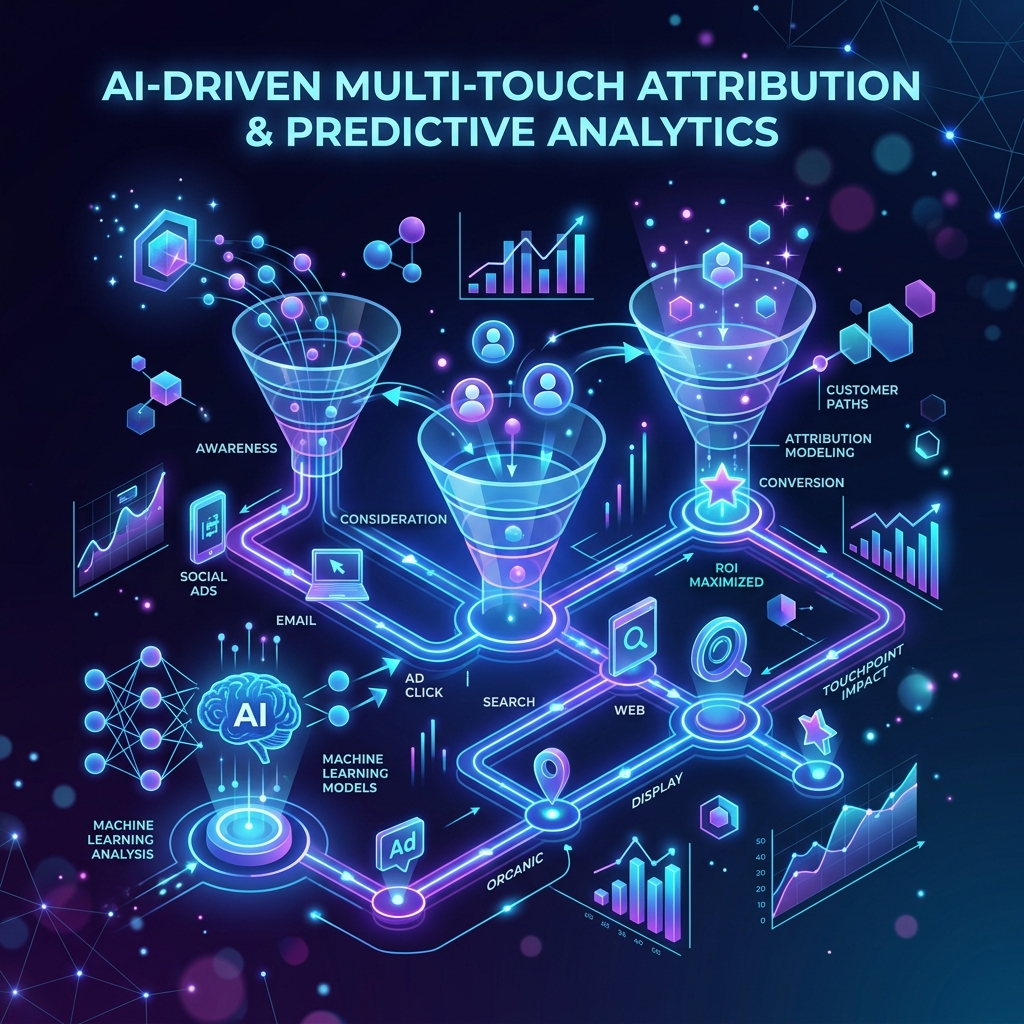
For over a decade, digital marketing was dominated by "Last-Click Attribution"—a model that gave 100% of the credit for a conversion to the final touchpoint (e.g., the last Google Ad clicked before purchasing). In 2026, last-click is widely recognized as fundamentally flawed because it ignores the complex, multi-channel reality of the modern customer journey.
The Rise of Data-Driven Attribution (DDA)
Major platforms, including Google Ads and GA4, have shifted to Data-Driven Attribution as the default model. DDA uses advanced machine learning algorithms to evaluate both converting and non-converting paths. It algorithmically assigns fractional credit to every touchpoint (organic search, email campaigns, social media, paid ads) based on its actual, calculated impact on driving the final conversion. If an informational blog post consistently appears early in the journey of high-value customers, DDA will recognize that value and assign credit to your SEO efforts, even if those users ultimately convert via a branded search ad weeks later.Multi-Touch Attribution (MTA) & Marketing Mix Modeling (MMM)
For enterprise brands and businesses with complex sales cycles, the gold standard is combining Multi-Touch Attribution with Marketing Mix Modeling (MMM).- →Multi-Touch Attribution (MTA) tracks individual user journeys across digital channels to attribute ROI. It requires robust identity resolution to connect user sessions across devices.
- →Marketing Mix Modeling (MMM), conversely, does not rely on user-level tracking. It uses econometric and statistical analysis on aggregate historical data to measure the impact of broad, non-trackable channels like TV commercials, podcast sponsorships, billboard advertising, and even external macroeconomic factors like seasonality or competitor pricing changes.
Comparison: Traditional vs. Modern Attribution
| Feature | Last-Click Attribution | Data-Driven Attribution (DDA) |
|---|---|---|
| Credit Assignment | 100% to the final interaction. | Fractional credit distributed across all touchpoints. |
| Accuracy | Low. Ignores brand awareness efforts. | High. Reflects the actual customer journey. |
| Methodology | Static, rule-based. | Dynamic, algorithmic, machine-learning based. |
| Best For | Simple, single-step sales funnels. | Complex, multi-channel B2B and e-commerce funnels. |
5. Privacy-First Measurement & Cookieless Analytics
With the deprecation of third-party cookies, tracking users across different domains is severely restricted. Privacy-first analytics is the strategy of measuring marketing performance while strictly adhering to user consent and data protection laws.
Server-Side Tagging
Traditionally, tracking scripts (like the Facebook Pixel or Google Analytics tag) ran in the user’s browser (Client-Side). In 2026, Server-Side Tagging is the industry standard. Instead of sending data directly from the browser to third-party vendors, the browser sends one stream of data to a cloud server you control. Your server then filters, sanitizes, and distributes the data to analytics and ad platforms. This provides maximum control over user privacy, hides your business logic from competitors, and significantly improves website load times, benefiting your Core Web Vitals.Consent Mode and Behavioral Modeling
When users decline tracking cookies via a consent banner, you experience data loss. Frameworks like GA4 Consent Mode v2 solve this. If consent is denied, no cookies are stored. Instead, anonymous "pings" are sent to Google. Machine learning models then analyze the behavior of users who *did* consent to accurately estimate and model the behavior of the unconsented users, bridging the gap in your reporting without violating privacy laws.6. The Imperative of First-Party Data Strategy
Because you can no longer rely on external advertising platforms to provide rich audience data, your first-party data strategy has become your most valuable marketing asset and competitive moat.
Understanding the Data Hierarchy
- →Zero-Party Data: Data that a customer intentionally and proactively shares with a brand. This includes preference center selections, purchase intentions, and responses to interactive quizzes.
- →First-Party Data: Data collected directly from your users based on their interactions with your website, app, or services, with their explicit consent. This includes CRM data, purchase history, and website behavioral tracking.
- →Third-Party Data: Data purchased from outside sources who are not the original collectors of that data. In 2026, this is largely obsolete and highly unreliable due to privacy crackdowns.
Building a Data Value Exchange
Users are increasingly protective of their personal information and are highly aware of its value. To acquire first-party and zero-party data, brands must offer a compelling "value exchange." You cannot simply ask for an email address without providing significant utility in return. Effective value exchanges include:- →Exclusive industry reports, proprietary research, or detailed whitepapers.
- →Interactive tools, ROI calculators, or personalized assessments.
- →Highly personalized product recommendations based on quiz results.
- →Loyalty program benefits, early access to sales, or exclusive community memberships.
The Role of Customer Data Platforms (CDPs)
To make first-party data actionable, modern businesses are investing heavily in Customer Data Platforms (CDPs) like Segment, Tealium, or native cloud data warehouses. A CDP centralizes fragmented data from all your marketing tools—website analytics, email marketing platforms, CRM systems, and customer support desks—into a single, unified, dynamic customer profile. This unified profile allows you to push highly targeted, personalized audience segments directly into your advertising platforms for precise, privacy-compliant retargeting.7. Real-Time Analytics & Marketing Dashboards
The speed of modern business requires agility. Waiting for a monthly PDF report to optimize campaigns is no longer acceptable. Real-time analytics enables marketers to monitor performance as it happens and make immediate strategic adjustments.
Dynamic Dashboards
Modern marketing dashboards pull live data via APIs. These dashboards are highly customized to specific roles. A CEO might see a high-level SEO KPI dashboard focused on pipeline velocity and Customer Acquisition Cost, while an SEO manager looks at real-time crawl logs, site performance metrics, and keyword ranking volatility via Google Search Console API integrations.Automated Triggers
Real-time data isn't just for viewing; it's for action. Marketing analytics tools are deeply integrated with automation platforms. If a real-time dashboard detects a sudden surge in traffic from a specific social media post, it can automatically trigger an increase in ad spend for that specific campaign to capitalize on the viral momentum, or alert the sales team to prepare for an influx of leads.8. Marketing Analytics KPIs Every Business Should Track
As data volume explodes, the ability to focus on the right metrics is crucial. Vanity metrics (like raw page views, social media followers, or uncontextualized impressions) are out. Value metrics that directly correlate with revenue are in.
Here are the essential marketing measurement KPIs for 2026:
- Customer Acquisition Cost (CAC): The total cost of sales and marketing efforts required to acquire a new customer. This must be tracked across all channels.
- Customer Lifetime Value (LTV / CLV): The total revenue a business expects from a single customer account throughout the business relationship.
- LTV:CAC Ratio: The ultimate indicator of marketing sustainability. A healthy SaaS or B2B business typically aims for an LTV:CAC ratio of 3:1 or higher.
- Return on Ad Spend (ROAS): The amount of revenue generated for every dollar spent on advertising, measured accurately using Data-Driven Attribution.
- Incremental Revenue: The revenue generated by a marketing campaign that *would not have occurred* without that campaign. This filters out users who would have purchased organically anyway, proving the true value of paid media.
- Engagement Rate: Replacing the outdated "Bounce Rate," engagement rate measures the percentage of sessions where a user actively interacted with the page, stayed longer than a set time limit, or triggered a conversion tracking event.
9. Common Analytics Mistakes to Avoid
Even with the best tools, implementation errors can ruin data integrity. Here is a checklist of common marketing analytics mistakes to avoid in 2026:
- →[ ] Ignoring Cross-Device Tracking: Failing to implement User IDs, leading to the same person being counted as three different users across their phone, tablet, and laptop. This heavily inflates user counts and destroys attribution modeling.
- →[ ] Siloed Data Ecosystems: Keeping CRM data separate from web analytics data, preventing you from tying top-of-funnel marketing campaigns to final closed-won revenue at the bottom of the funnel.
- →[ ] Misconfigured Consent Management: Implementing a cookie banner that visually blocks cookies but fails to properly fire the necessary technical signals (like GA4 Consent Mode parameters) to the analytics platform, resulting in massive compliance risks and unnecessary data loss.
- →[ ] Tracking Vanity Metrics Over Business Impact: Optimizing campaigns solely for clicks and traffic rather than qualified leads, pipeline generation, and actual revenue.
- →[ ] Failing to Track Offline Conversions: Neglecting to upload offline sales data (like in-store purchases, CRM deal stages, or phone-call closures) back into your ad platforms. This deprives bidding algorithms of the critical data they need to optimize for high-value customers.
10. Best Marketing Analytics Tools in 2026
The marketing technology stack has consolidated significantly, with leading platforms offering increasingly robust native integrations and AI capabilities. Here are the top tools shaping the industry:
Google Analytics 4 (GA4)
GA4 remains the undisputed industry standard for web and app analytics. Rebuilt entirely from the ground up to support event-based tracking rather than session-based tracking, GA4 natively integrates machine learning for behavioral modeling and predictive audiences. Its seamless integration with the Google Ads ecosystem and Google BigQuery makes it the most powerful free tool available for marketers seeking advanced data manipulation.Adobe Analytics
For enterprise-level organizations, Adobe Analytics is the preferred choice. While it presents a steeper learning curve than GA4, Adobe offers unparalleled customization, deep real-time segmentation capabilities, and massive processing power for handling complex, multi-brand data environments. Its integration into the broader Adobe Experience Cloud allows for incredibly sophisticated cross-channel personalization.Microsoft Clarity
Microsoft Clarity has emerged as a phenomenal, privacy-focused qualitative analytics tool. While GA4 tells you *what* users are doing, Clarity helps you understand *why*. It provides session recordings, heatmaps, dead-click tracking, and rage-click metrics. In 2026, Clarity’s AI integration automatically summarizes user sessions and provides text-based insights, drastically reducing the time needed to manually analyze user experience (UX) friction points.HubSpot Marketing Hub
HubSpot is an all-in-one solution that seamlessly connects marketing analytics with CRM data. HubSpot excels at full-funnel closed-loop reporting. For B2B marketers, the ability to trace a final closed-won enterprise deal back to the very first blog post the prospect read is invaluable. HubSpot’s built-in attribution reporting simplifies what traditionally required complex data warehousing.Specialized SEO Analytics Tools
For organic search specifically, platforms like Ahrefs and Semrush continue to evolve their analytics dashboards, integrating AI to provide predictive keyword difficulty scores and automated content gap analysis. Meanwhile, tools designed to deeply analyze the Google Search Console remain the foundational source of truth for organic visibility, indexation health, and algorithmic performance.11. The Future of Marketing Analytics
As we look beyond 2026, several nascent technologies are poised to shape the next era of marketing measurement.
Immersive Data & Spatial Analytics: As Augmented Reality (AR) and Virtual Reality (VR) adoption grows, analytics will shift from 2D web clicks to spatial analytics—tracking gaze direction, physical interaction with virtual objects, and environmental context. This will require entirely new measurement frameworks.
Edge Computing: To improve site speed and enhance data security, analytics processing will increasingly move to the "edge" (closer to the user's device). This allows for near-instant personalization without sending vast amounts of raw data back to centralized cloud servers, improving both performance and privacy compliance.
Decentralized Data Ownership: Driven by emerging internet philosophies, we may see a shift toward users owning their data profiles in secure, encrypted environments, granting temporary, revocable access to brands in exchange for tailored experiences or exclusive access, fundamentally altering the concept of first-party data collection.
12. Official References
- →Think with Google: The Future of Measurement
- →Google Analytics Help: Predictive metrics in GA4
- →Google Analytics Help: About data-driven attribution
- →Google Tag Manager: Server-side tagging
- →Gartner: The State of Marketing Analytics
13. Conclusion
Marketing analytics in 2026 represents a fundamental evolution from the practices of the past decade. The era of easy, highly granular, third-party data collection is behind us. However, this is not a loss; it is an incredible opportunity.
By embracing marketing analytics trends like AI predictive modeling, data-driven attribution, and robust first-party data strategies, brands can build measurement frameworks that are far more sophisticated and resilient than ever before. The future belongs to marketers who respect user privacy while leveraging the immense power of machine learning to uncover the strategic insights hidden within their data.
Audit your setup regularly, focus on high-quality content that meets E-E-A-T expectations, and monitor performance indicators closely.
To deepen your technical expertise, read our guides on Google Analytics 4: A Complete Guide for SEO Professionals, GA4 Consent Mode v2 Explained, and Website Analytics Audit Checklist.
Frequently Asked Questions
What are the main marketing analytics trends for 2026?
The biggest trends include AI-powered predictive analytics, the complete shift to privacy-first cookieless tracking (like GA4 Consent Mode), server-side tagging, and the adoption of advanced multi-touch attribution models.
How is AI changing marketing analytics?
AI automates anomaly detection, predicts customer churn, forecasts lifetime value (LTV), and provides natural language queries for dashboards, turning raw data into actionable, strategic insights instantly.
What is privacy-first measurement?
Privacy-first measurement relies on tracking frameworks that respect user consent choices, using anonymous pings and machine learning (like GA4 behavioral modeling) to fill data gaps instead of invasive third-party cookies.
Why is first-party data so important now?
With the death of third-party cookies, first-party data (data collected directly from your users with their consent) is the only reliable source for ad targeting, personalization, and accurate audience segmentation.
Which analytics metrics matter most in 2026?
Instead of vanity metrics, marketers are focusing on Customer Acquisition Cost (CAC), Customer Lifetime Value (CLV/LTV), Return on Ad Spend (ROAS), and incremental revenue driven by specific campaigns.

Founder & Editor, TechSEO Insights
Mehul Makavana writes practical SEO, AI tools, and web development guides based on hands-on research, testing, and real website optimization work.
Subscribe to TechSEO Insights
Get the latest guides on technical SEO, Core Web Vitals, and content marketing delivered straight to your inbox.
Privacy Note: By subscribing, you agree to receive our newsletter (Lawful Basis: Consent). We retain your email address until you choose to unsubscribe. For more details, view our Privacy Policy.