How to Optimize Content for Featured Snippets and People Also Ask (PAA)
Learn how to use structured lists, tables, and Q&A formatting to secure top-tier position zero placements and PAA accordions.
Key Takeaways
- Featured snippets display a direct summary answer at the top of search listings.
- Writing a concise Q&A block (40-60 words) under heading queries targets snippets.
- Structuring data in HTML tables helps Google pull comparison answers.
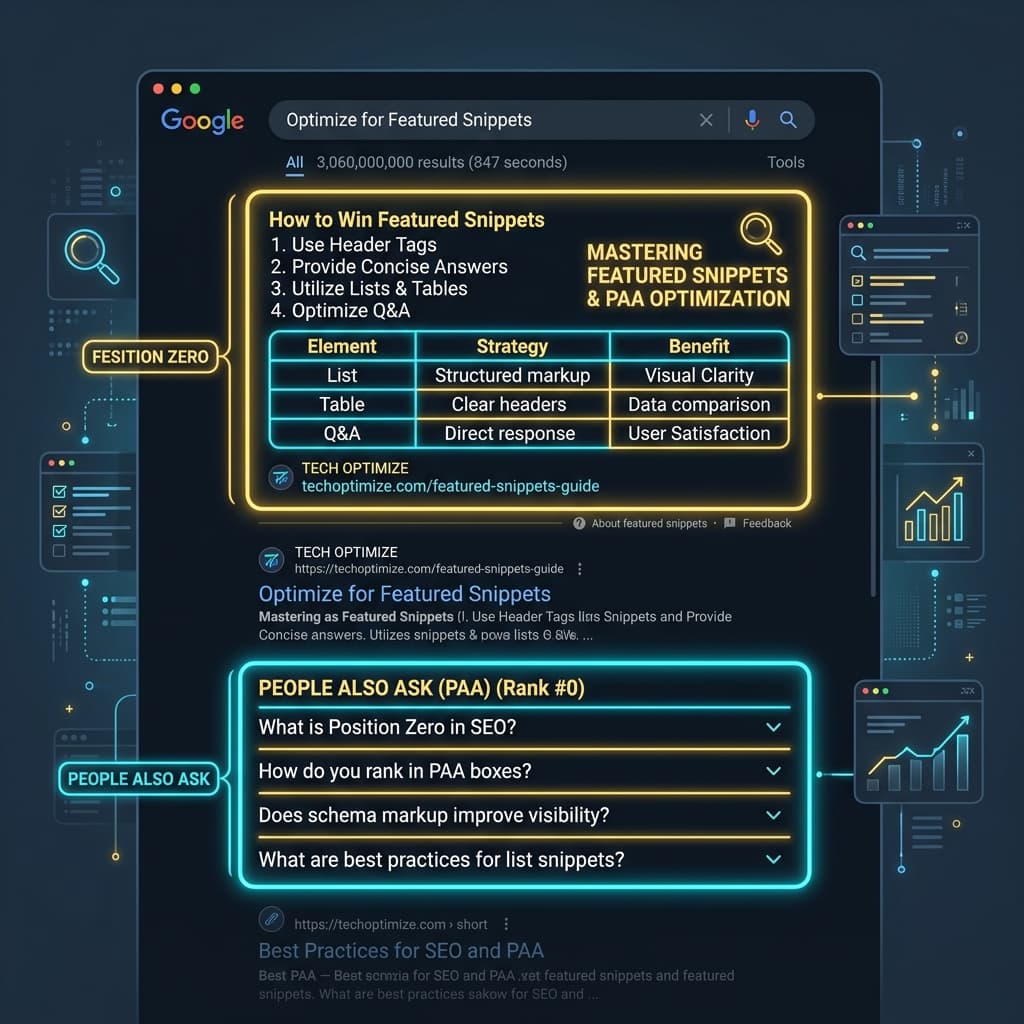
Earning a first-page ranking on Google is no longer enough to guarantee organic traffic. With the rise of AI-generated summaries and zero-click searches, search results pages are increasingly dominated by Featured Snippets and People Also Ask (PAA) panels.
Located above the traditional blue links, these features are known as Position Zero. Winning these placements allows your brand to capture the majority of clicks for informational searches, establish topical authority, and pull traffic away from higher-domain competitors.
To win these slots, you must structure your content to align with the extraction templates used by Google's natural language processing models.
1. The Three Types of Featured Snippets and How to Format Them
Google programmatically extracts text blocks from web pages to compile featured answers. The formatting you use tells the crawler what type of data your page contains:
1. The Paragraph Snippet (Definitions & Explanations)
Paragraph snippets answer queries starting with "What is," "Who is," or "Why does."- →The Format Rule: Place a clear, objective definition of 40 to 60 words (roughly 250 to 350 characters) directly under an
H2orH3heading that matches the query. - →Style Tip: Start the definition with a declarative statement using active voice. Avoid introductory filler text.
## What is [Next.js](/blog/nextjs-seo-best-practices) Hydration?

Next.js hydration is the React process where client-side JavaScript attaches event listeners and state objects to the static HTML pages pre-rendered on the server. This process transforms a static read-only web page into an interactive, dynamic web application in the browser.
2. The List Snippet (Steps & Lists)
List snippets answer queries starting with "How to," "How do I," or "What are."- →The Format Rule: Use clean, semantic HTML ordered lists (
<ol>) or unordered lists (<ul>) directly under your target heading. - →Alternative: Google will also compile list snippets by pulling consecutive subheadings (
H3tags) from a single article.
## How to Resolve CSS Render-Blocking Delays

1. Identify critical above-the-fold styling rules.
2. Inline the critical CSS directly into the HTML document header.
3. Defer non-critical stylesheets by loading them asynchronously.
4. Minify all outbound CSS bundles using cssnano.
3. The Table Snippet (Comparisons & Data)
Table snippets answer queries looking for structured comparisons, pricing lists, or numeric data.- →The Format Rule: Do not use CSS Flexbox or CSS Grid layouts for tabular data. Google's parser expects semantic HTML table tags (
<table>,<thead>,<tbody>,<tr>,<th>,<td>).
<table>
  <thead>
    <tr>
      <th>Protocol</th>
      <th>Transport Layer</th>
      <th>Handshake Speed</th>
    </tr>
  </thead>
  <tbody>
    <tr>
      <td>HTTP/2</td>
      <td>TCP</td>
      <td>2-3 Round Trips</td>
    </tr>
    <tr>
      <td>HTTP/3</td>
      <td>UDP (QUIC)</td>
      <td>0-1 Round Trips</td>
    </tr>
  </tbody>
</table>
2. Optimizing for "People Also Ask" (PAA) Accordions
The PAA section dynamically generates a list of related questions based on the user's initial query. When a user clicks a question, the accordion expands to show a snippet of text extracted from a matching website.
To capture these placements:
- Map the PAA Tree: Search your primary keyword on Google and extract the list of questions generated in the PAA box.
- Add a Dedicated FAQ Section: Place a Q&A or FAQ section at the end of your articles to address these queries directly.
- Use FAQPage Schema: Structure your FAQs using JSON-LD schema. This helps crawlers identify your questions and answers instantly.
Official References
Frequently Asked Questions
How does PAA optimization differ from featured snippets?
PAA optimization requires addressing multiple adjacent informational queries, whereas featured snippets target a single primary search query.
What is the optimal paragraph snippet length?
Keep paragraph definition snippets between 40 and 60 words (approximately 250 to 350 characters) to fit Google's search card container perfectly.
Can a site without a top-3 ranking win a featured snippet?
Yes, but it is rare. Over 90% of featured snippets are pulled from pages ranking in the top 5 organic results for that query.
How do I format content to win featured snippets?
Use short, direct paragraphs (40-50 words) right below the target H2/H3 question. You can also use clean HTML tables or ordered lists for list snippets.
Does schema markup help in winning PAA boxes?
Yes, incorporating FAQPage and BreadcrumbList schema signals structure to Googlebot, increasing the probability of showing up in People Also Ask results.
Why did my featured snippet ranking disappear?
Snippet ownership is highly dynamic. Google continuously tests different pages. It can disappear if your content becomes outdated, or if a competitor writes a more concise response.

Founder & Editor, TechSEO Insights
The TechSEO Editorial Team writes practical SEO, AI tools, and web development guides based on hands-on research, testing, and real website optimization work.
Subscribe to TechSEO Insights
Get the latest guides on technical SEO, Core Web Vitals, and content marketing delivered straight to your inbox.
Privacy Note: By subscribing, you agree to receive our newsletter (Lawful Basis: Consent). We retain your email address until you choose to unsubscribe. For more details, view our Privacy Policy.