How to Build a Topical Authority Map to Dominate High-Competition Niches
Create comprehensive topical authority maps using entity databases, semantic search queries, and content hub architectures.
Key Takeaways
- Topical authority requires covering all semantic subtopics related to your core niche.
- A topic map maps keyword nodes to pillar hubs and sub-pages.
- Internal links must pass topical context down the hierarchy.
In the early days of SEO, ranking for competitive terms was simple: choose a target keyword, write a page optimized for that term, and buy or build as many backlinks as possible. Today, search engine algorithms are far more sophisticated. Google's transition from strings to things (entities) means that rankings are determined by topical authority rather than link volume or keyword density alone.
Topical authority is a measure of a website's depth of expertise on a specific subject. Search engines evaluate whether you have covered every secondary question, semantic entity, and subtopic related to your primary theme. To build this authority, you must construct a structured topical authority map.
1. What is a Topical Authority Map?
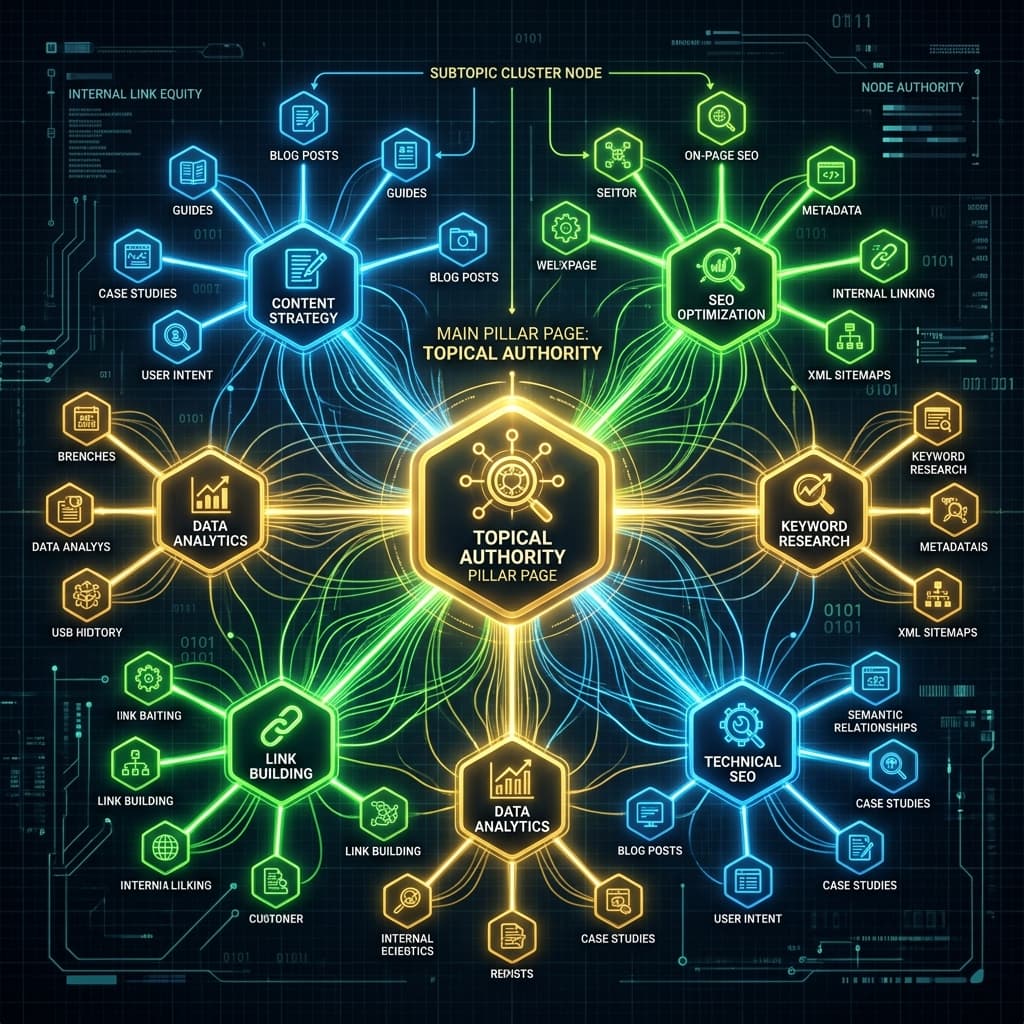
A topical authority map is a visual and structural blueprint of all the content needed to exhaustively cover a specific subject. Instead of treating articles as isolated pages, a topical map organizes content into hierarchical clusters using a Hub-and-Spoke model:
- →Pillar Pages (The Hub): A broad, comprehensive page that serves as the ultimate resource for a high-volume target keyword. It links out to all related subtopics but does not go into excessive detail on any single one.
- →Cluster Pages (The Spokes): Highly targeted sub-articles that dive deep into specific long-tail queries, technical definitions, or niche questions.
- →Semantic Interlinking: A system of logical internal hyperlinks that pass topical context and crawl equity between the spokes and the pillar page.
2. Step-by-Step Guide to Mapping Your Topic
To build a topical map that establishes trust with search engines, follow these four stages:
Step 1: Define Your Core Entity (The Root Node)
Start by identifying the primary topic you want to dominate. This should be a broad entity that relates directly to your business. For example, rather than choosing "nextjs routing," choose the broader root entity "Next.js Development" or "Technical SEO".Step 2: Semantic Research and Entity Mining
Next, identify all related entities and subtopics. Do not rely solely on traditional keyword research tools. Instead, mine semantic sources:- →Google People Also Ask (PAA): Collect the questions users ask about your root topic.
- →Wikipedia Categories: Look at the category subtrees of your topic's Wikipedia entry to find related concepts.
- →Google's NLP API: Run top competitor articles through natural language processing tools to extract the entities (nouns, organizations, concepts) they cover.
- →Search Engine Autocomplete: Gather search suggestions to capture real user queries.
Step 3: Cluster the Keywords by Intent
Group your list of terms into distinct thematic clusters. Each cluster represents a spoke page. Make sure each page covers a single, distinct search intent. If two keywords share the same intent (e.g., "Next.js page speed" and "how to speed up Next.js"), combine them into one article rather than creating duplicate pages.3. Designing a Semantic Interlinking Architecture
Internal links are the pathways that search engine crawlers use to discover your pages and understand their relationships. Without proper linking, your topical map will fail to pass authority.
graph TD
    Pillar["Pillar Page: Next.js Performance"]
    Spoke1["Spoke 1: Image Optimization"]
    Spoke2["Spoke 2: Hydration Errors"]
    Spoke3["Spoke 3: Route Caching"]

    Pillar -->|Links to| Spoke1
    Pillar -->|Links to| Spoke2
    Pillar -->|Links to| Spoke3

    Spoke1 -->|Links back to| Pillar
    Spoke2 -->|Links back to| Pillar
    Spoke3 -->|Links back to| Pillar

    Spoke1 <-->|Lateral link| Spoke2
    Spoke2 <-->|Lateral link| Spoke3
The Three Rules of Semantic Linking:
- Bidirectional Pillar-Spoke Links: The pillar page must link to every spoke article, and every spoke article must link back to the main pillar page using descriptive anchor text.
- Lateral Spoke Links: Spoke articles within the same cluster should link to one another when relevant. This reinforces the semantic boundary of the cluster.
- Contextual Anchor Text: Avoid generic link text like "click here" or "read more." Instead, use anchors that contain the target entity (e.g., "...to resolve Next.js hydration mismatches, use the following pattern...").
4. Measuring Your Topical Authority
Once you publish your content clusters, track these metrics to evaluate your topical authority:
- →Cluster Indexation Rate: Ensure that all spoke articles are fully crawled and indexed by search engines.
- →Keyword Share of Voice: Monitor how many keywords within the cluster rank on the first page of search results.
- →Topical Backlink Growth: Track whether other high-authority sites are linking to your cluster pages as references.
- →Internal Link Flow: Use tools like Google Search Console to verify that your pillar pages are receiving the highest volume of internal link citations on your site.
Official References
Frequently Asked Questions
How long does it take to build topical authority?
It typically takes 3 to 6 months of publishing comprehensive clusters and earning topical backlinks to rank for competitive head terms.
How do search engines evaluate topical authority?
Search engines use NLP (Natural Language Processing) and knowledge graph matching to evaluate the depth, semantic completeness, and logical linking structure of your content.
What is the difference between a keyword map and a topical authority map?
Keyword mapping focuses on matching pages to specific search queries. Topical mapping focuses on organizing pages around semantic entities and relationships, ensuring complete topic coverage.
How do I identify topical gaps in my map?
Perform competitor gap analysis using Semrush or Ahrefs, crawl their topical structure, and check Google People Also Ask questions to see uncovered queries.
How many articles should be in a topic cluster?
It depends on the niche complexity. Broad topics may require 20 to 50 articles, whereas smaller sub-niches can be covered in 5 to 10 articles.
What is search intent mapping in topical SEO?
It is the practice of matching each topical page to a specific user search intent (informational, commercial, navigational) to prevent keyword cannibalization.

Founder & Editor, TechSEO Insights
The TechSEO Editorial Team writes practical SEO, AI tools, and web development guides based on hands-on research, testing, and real website optimization work.
Subscribe to TechSEO Insights
Get the latest guides on technical SEO, Core Web Vitals, and content marketing delivered straight to your inbox.
Privacy Note: By subscribing, you agree to receive our newsletter (Lawful Basis: Consent). We retain your email address until you choose to unsubscribe. For more details, view our Privacy Policy.