Headless CMS SEO Guide: Optimizing Decoupled Architectures
Learn how to optimize headless CMS architectures for SEO with content modeling strategies, structured data APIs, preview environments, and URL management.

Advertisement
Key Takeaways
- Content modeling directly impacts your ability to generate proper semantic HTML and structured data
- API response times affect page speed and Core Web Vitals
- Preview environments must support search engine testing
- URL structures should be managed in the CMS, not hard-coded in the front end
- incremental static regeneration or webhooks keep content fresh across the decoupled system
Headless CMS architectures separate content management from content presentation. This decoupling offers flexibility for developers but creates unique SEO challenges. When your content lives in a CMS and renders on a separate front-end, maintaining search visibility requires careful planning.
A headless CMS provides content through APIs. Your front-end framework, whether Next.js, Gatsby, or a custom React app, fetches this content and renders it for users and search engines. This architecture affects how content is structured, delivered, and indexed.
Content Modeling for SEO
Your content model determines what structured data, meta information, and semantic HTML you can generate. Model your content to support SEO requirements from the start.
Critical Fields for Every Content Type
Every content type should include fields for meta title, meta description, canonical URL, Open Graph image, and slug. These fields map directly to HTML elements that search engines use.
Include a dedicated field for structured data overrides. Some pages may need custom schema markup that differs from the default. A raw JSON field allows content editors to inject specialized structured data.
Rich Text and Semantic HTML
Most headless CMS platforms provide rich text editors that output HTML. Configure your rich text field to produce semantic HTML with proper heading hierarchy, lists, and link attributes.
Strip inline styles from rich text output. Semantic HTML should rely on CSS classes rather than inline styles. This ensures consistent styling and cleaner HTML for search engines.
Image Fields and Metadata
Content images need dedicated fields for alt text at minimum. Consider adding fields for caption, credit, and focal point.
Alt text should be a required field for all images. Empty alt attributes harm accessibility and limit image search visibility. For our take on accessibility and search, see Web Accessibility and SEO.
API Performance
When your front-end fetches content from a CMS API, response times directly affect page speed. GraphQL APIs offer advantages over REST for headless CMS architectures.
GraphQL vs REST
GraphQL allows you to request exactly the fields you need. This eliminates over-fetching and reduces payload sizes. For a blog page, you might query only the title, body, and meta fields instead of receiving the entire content object.
REST endpoints typically return fixed responses. You may receive fields you do not need, increasing payload size and response time.
Caching Strategies
Implement caching at multiple levels. Cache API responses at the CDN level, the application layer, and the browser.
Use CDN caching for content that changes infrequently. Set appropriate Cache-Control headers based on content freshness requirements. A blog post can be cached for hours or days. A breaking news article needs shorter cache durations.
Webhook-Based Invalidation
When content changes, have your CMS send webhooks to your front-end host. This triggers revalidation or rebuild of affected pages.
Netlify and Vercel support webhook-based rebuilds. Your CMS can send a webhook when an editor publishes, updates, or deletes content. The front-end then regenerates only the affected pages.
URL Management
URL structures must be controlled from the CMS, not hard-coded in the front-end application. This allows content editors to create SEO-friendly URLs without developer involvement.
Slug Generation
Configure your CMS to auto-generate slugs from content titles. Allow manual overrides for cases where the auto-generated slug is not ideal.
Prevent duplicate slugs by appending a unique identifier when collisions occur. Search engines penalize duplicate content, and duplicate URLs compound the problem.
Canonical URLs
Include a canonical URL field in your content model. This field allows editors to specify the preferred URL when content exists in multiple locations.
Set default canonical URLs based on the standard content path. Override only when necessary for cross-domain syndication or consolidated pages.
Structured Data from CMS
Your CMS should generate structured data that the front-end renders as JSON-LD. Model structured data fields alongside your content fields.
Schema Types
Support common schema types based on your content types. Articles need Article or BlogPosting schema. Products need Product schema with offers, reviews, and aggregate ratings.
Use a schema builder plugin or custom module to generate proper JSON-LD. Validate all structured data before publishing using Google Rich Results Test.
Dynamic Structured Data
Some structured data elements depend on runtime state. Breadcrumb lists need current page context. Review snippets need aggregate data from multiple sources.
Handle dynamic structured data in your front-end application using the structured data from your CMS as a base. Merge runtime data with CMS-provided schema to produce complete markup.
Preview Environments
Preview environments let content editors see how content will look before publishing. These environments must support SEO testing.
Noindex Preview URLs
Preview URLs should include a meta robots noindex tag and an X-Robots-Tag HTTP header. This prevents search engines from indexing draft or preview content.
Configure your preview routes to automatically inject noindex directives. An environment variable can control this behavior.
Structured Data Validation in Previews
Preview environments should show structured data validation results. Editors should see warnings about missing required fields or invalid schema before content goes live.
Integrate structured data testing into your preview workflow. This catches SEO issues before they reach production.
Practical Implementation
A media company rebuilt their site with a headless CMS and Next.js front-end. They modeled content with dedicated SEO fields, implemented webhook-based revalidation, and set up preview environments with noindex protection.
Page load times decreased by 60 percent. Indexed pages increased by 35 percent because the static front-end delivered content faster to Googlebot. Organic traffic grew by 28 percent over six months.
For a broader SEO audit approach that complements headless CMS implementation, see our Technical SEO Audit Checklist.
SEO Automation with Headless CMS
Automate SEO tasks through your headless CMS workflow. Generate XML sitemaps automatically when content is published or updated. Send sitemap update pings to Google and Bing through the CMS webhook system.
Implement automated redirect management. When an editor changes a URL slug, the CMS should automatically create a redirect from the old URL to the new one. This prevents broken links and preserves link equity.
Use the CMS to manage robots.txt directives at the content level. Some pages may need noindex tags based on content type or quality. A content editor should be able to set indexing preferences without developer intervention.
Headless CMS and International SEO
Headless CMS architectures excel at supporting international SEO. Content can be modeled with locale-specific fields, and the API can serve localized content based on user location or language preferences.
Implement hreflang tags in your headless CMS. Configure language and regional variants for each piece of content. The front-end renders the appropriate hreflang tags in the HTML head.
International URL structures should be managed in the CMS. Use subdirectories for language variants or subdomains based on your SEO strategy. The CMS should allow editors to specify the URL structure for each locale.
Structured Content and Rich Results
Headless CMS content modeling directly affects your ability to generate rich results. Model your content with structured data requirements in mind.
Create content types that map to schema.org types. An article content type should have fields for headline, author, date published, and featured image. These fields map directly to Article schema properties.
Use your CMS to manage FAQ schema content. The question and answer pairs can be modeled as a repeatable field group. The front-end renders these as FAQPage structured data.
Content Delivery and CDN Integration
Many headless CMS providers offer built-in CDN integration for content delivery. Contentful, Strapi, and Prismic all serve content through global CDNs. This ensures fast API response times regardless of user location.
Configure your front-end to fetch content from the nearest CDN edge. Most CMS SDKs handle this automatically. Verify that your content delivery path is optimized by testing from multiple geographic locations.
Technical Implementation Steps
- Analyze Current State: Review Google Search Console crawling stats.
- Identify Errors: Filter by 4xx/5xx status codes.
- Map Redirects: Draft 301 redirects maps for any moved URLs.
- Verify Implementation: Run Lighthouse CI/Screaming Frog audit.
- Monitor GSC: Verify Google has updated the index successfully.
Common Mistakes
- →Blocking JavaScript & CSS in robots.txt: Googlebot needs to render layout styles to calculate Core Web Vitals like CLS and LCP accurately.
- →Not Preloading Critical Hero Images: Forgetting to preload the LCP image delays rendering, resulting in a poor Lighthouse speed score.
- →Ignoring Client-Side Render Latency: Relying entirely on client-side JS executing without an HTML backup blocks indexation on other search engines like Bing.
When This Does Not Apply
- →Static Marketing Pages: Simple, light static sites with minimal dynamic elements rarely need complex server-rendering, database connections, or API performance strategies.
- →Non-Indexed Portals: Staging sites, dashboard pages behind authentication, or internal company wikis do not benefit from structured data or search engine indexability optimization.
Official References
Advertisement
Frequently Asked Questions
Is headless CMS good for SEO?
Yes, when implemented correctly. Headless CMS architectures can deliver better performance through static generation and CDN delivery. The key is modeling content properly and managing URLs, metadata, and structured data from the CMS.
Which headless CMS is best for SEO?
Contentful, Strapi, and Prismic all support SEO-optimized content modeling. The best choice depends on your team workflow and budget. Any of these can produce SEO-friendly output with proper configuration.
How do I handle redirects in a headless CMS?
Manage redirects in the CMS and expose them through a redirects API endpoint. Your front-end fetches this endpoint on build or at runtime and implements the redirects.
Does a headless CMS affect Core Web Vitals?
Indirectly, yes. API response times from your CMS affect page speed. Use GraphQL to minimize payloads, implement caching, and consider a CDN that supports edge caching of API responses.
Can I use dynamic rendering with a headless CMS?
Yes. Dynamic rendering works with any content source. The pre-renderer fetches content from your CMS API just like the client-side application would.

Technical SEO Specialist & Web Performance Engineer
Daniel Ashcroft is a Technical SEO Specialist with 9+ years of experience optimizing enterprise web applications for search performance. He specializes in Next.js architecture, Core Web Vitals, and technical SEO implementations that bridge development and marketing. He has led SEO migrations for Fortune 500 companies, managed crawl optimization for million-page sites, and built automated auditing tools used by agencies worldwide. Daniel has helped clients achieve 40%+ organic traffic improvements through JavaScript SEO, server-side rendering, and performance optimization. He is a regular speaker at BrightonSEO, SMX, and SearchLove, contributing to publications including Search Engine Land and Moz Blog. Daniel is committed to making the web faster, more accessible, and more discoverable through technical excellence.
Comments are temporarily unavailable.
Stay Updated
Get the latest articles and SEO insights delivered to your inbox.
No spam. Unsubscribe anytime.
Related Articles
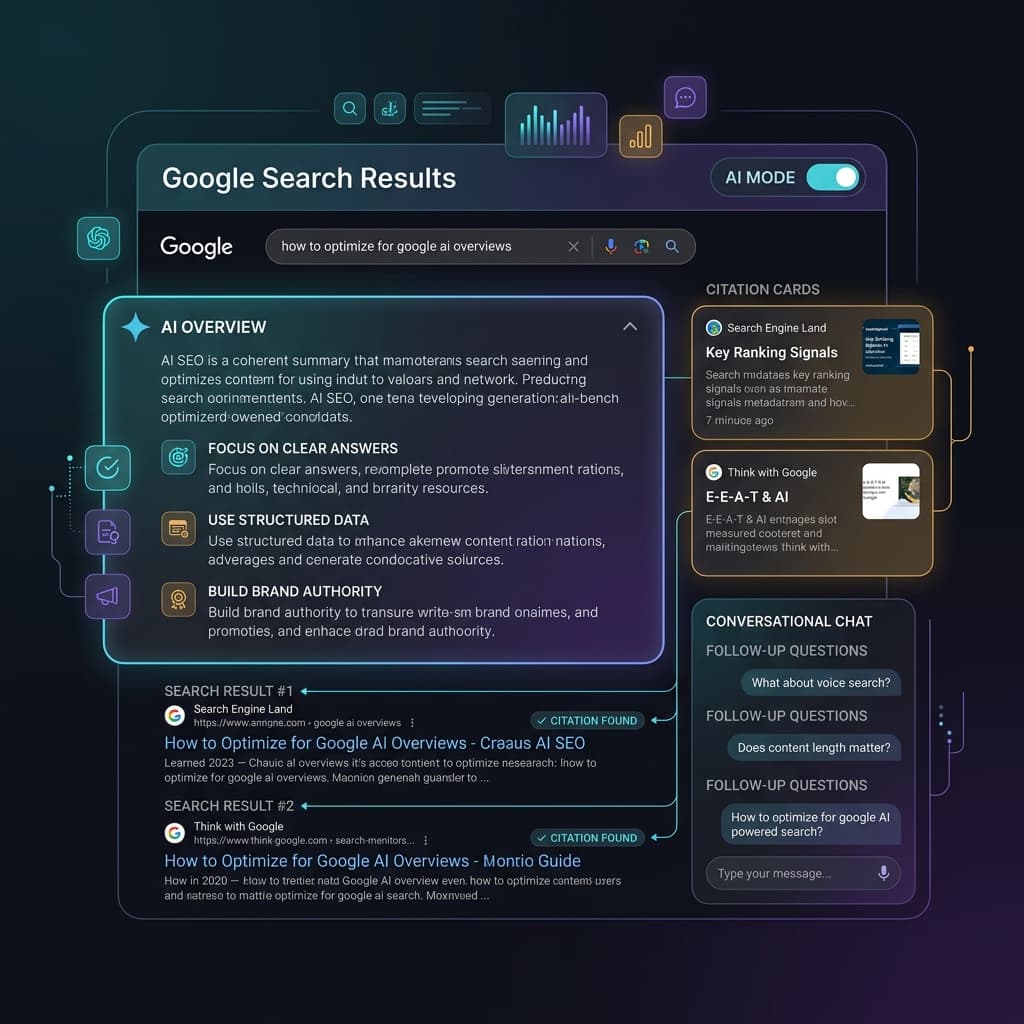
Google AI Overviews and AI Mode SEO: A Practical Visibility Framework (2026)
An in-depth guide to achieving high visibility in Google AI Overviews and AI Mode conversational search. Learn the RAG pipeline, key ranking factors, E-E-A-T requirements, and structured data optimization.

Core Web Vitals Debugging Playbook: Diagnose and Fix LCP, INP, and CLS Issues
Stop guessing why your Core Web Vitals are failing. Learn a systematic debugging workflow for LCP, INP, and CLS issues with real diagnostic techniques, CrUX analysis, and framework-specific fixes.

Internal Linking Strategy for SEO: A Complete Framework
Build an internal linking framework that distributes link equity, establishes content relationships, and drives rankings across your entire site.
Advertisement