JavaScript Framework SEO Comparison: React, Vue, Angular, Svelte in 2026
Compare React, Next.js, Vue, Nuxt, Angular, and SvelteKit for SEO performance. Analysis of SSR capabilities, Core Web Vitals impact, and search engine compatibility.
Advertisement
Key Takeaways
- Next.js and Nuxt provide the most [complete](/blog/complete-guide-to-core-web-vitals-2026) SSR/SSG support for their respective ecosystems
- SvelteKit offers excellent performance with minimal JavaScript overhead
- Angular Universal supports SSR but has a steeper learning curve
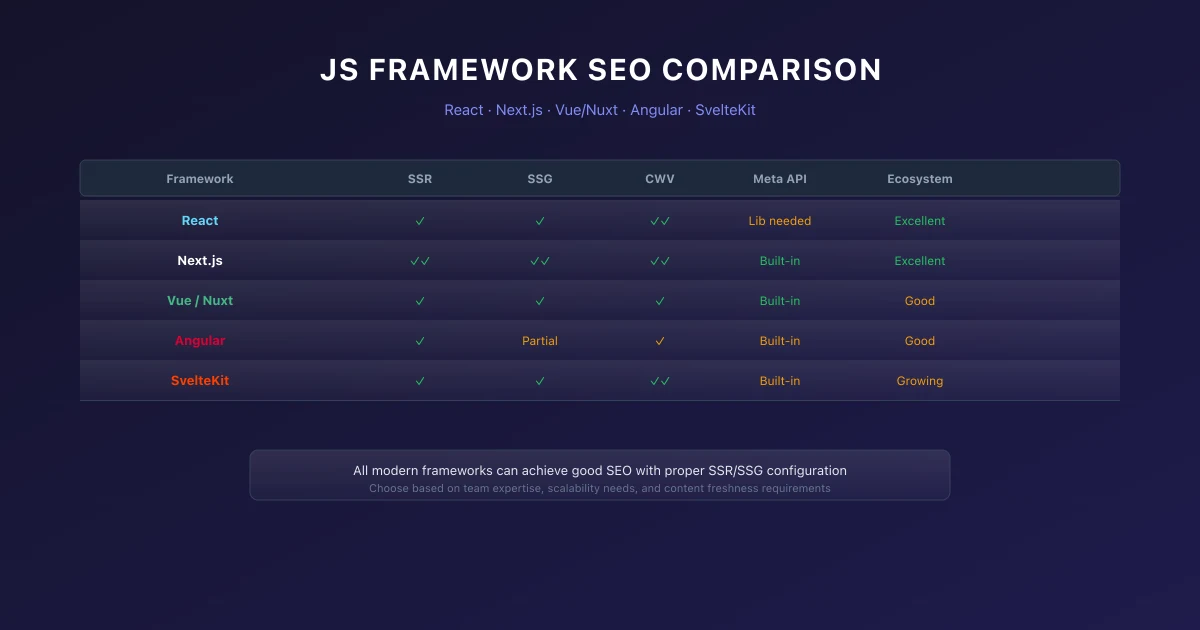
- All frameworks can achieve good SEO with proper configuration
- Performance differences are narrowing, but [Next.js](/blog/nextjs-seo-best-practices) leads in ecosystem maturity
- Choose based on your team expertise and project requirements, not just SEO features
Choosing a JavaScript framework has major implications for SEO. Each framework approaches rendering, performance, and metadata management differently. This comparison evaluates the major frameworks based on their SEO capabilities, helping you make an informed decision.
The evaluation covers default rendering behavior, SSR/SSG support, metadata management, performance characteristics, and real-world search engine compatibility.
Evaluation Criteria
We evaluated each framework on five criteria that directly affect SEO: rendering flexibility, metadata management, structured data support, performance characteristics, and community maturity.
Rendering Flexibility
The ability to choose between SSR, SSG, and ISR per page or per route is critical for SEO. Frameworks that support multiple rendering strategies provide the most flexibility.
Metadata Management
Built-in metadata APIs reduce complexity and ensure consistency. Frameworks with first-party metadata solutions are easier to optimize than those requiring third-party libraries.
Performance Characteristics
Bundle size, runtime overhead, and optimization defaults affect Core Web Vitals. Frameworks with smaller runtime footprints have inherent performance advantages.
Next.js
Next.js remains the gold standard for SEO-focused React applications. It supports SSR, SSG, ISR, and edge rendering with per-page configuration.
Rendering
The App Router provides flexible rendering options. Each route can use static generation, server-side rendering, or incremental static regeneration. This flexibility allows you to optimize each page type for SEO.
Next.js ISR is unique in the ecosystem. It combines the performance benefits of static generation with content freshness.
Metadata
The built-in Metadata API eliminates third-party dependencies. It supports automatic Open Graph image generation, dynamic metadata, and layout-level defaults.
Performance defaults are strong. Automatic code splitting, image optimization, and font optimization come out of the box.
Shopify uses Next.js for their online store framework. Store owners benefit from the SEO capabilities built into the platform.
Vue and Nuxt
Nuxt provides Next.js-like capabilities for the Vue ecosystem. It supports SSR, SSG, and ISR through its hybrid rendering system.
Rendering Options
Nuxt offers route rules that define rendering behavior per page. You can configure some routes as static, others as server-rendered, all from a single configuration file.
The nuxt generate command produces a fully static site. The nuxt build command with SSR produces a server-rendered application.
Metadata and SEO
useHead composable allows per-page metadata management. It supports title, meta, link, and script tags with full reactivity.
Nuxt SEO module provides additional features including sitemap generation, robots.txt management, and structured data helpers. This ecosystem makes Nuxt competitive with Next.js for SEO.
Vue.js core team uses Nuxt for the official Vue documentation. The site achieves perfect Lighthouse scores and strong search visibility.
Angular
Angular Universal enables server-side rendering for Angular applications. It is less commonly used for content-focused sites but capable for enterprise applications.
Rendering with Angular Universal
Angular Universal pre-renders pages on the server and sends HTML to the client. After the initial render, Angular hydrates and takes over as a client-side application.
The transfer state mechanism passes server-fetched data to the client, preventing duplicate API calls. This improves perceived performance.
Metadata in Angular
The Meta and Title services allow programmatic metadata management. You can set title and meta tags from components and services.
Angular does not provide built-in image optimization or font optimization. These require additional tools or manual configuration.
Google uses Angular for many internal applications. Angular Universal ensures that publicly accessible sites built with Angular can be indexed effectively.
Svelte and SvelteKit
SvelteKit is the official application framework for Svelte. It has gained popularity for its minimal JavaScript output and excellent performance.
Rendering Options
SvelteKit supports SSR, SSG, and a unique option: prerendering. Prerendered pages are static HTML with no JavaScript. This produces the fastest possible pages.
The +page.ts module allows per-page rendering configuration. You can mix static pages with server-rendered pages in the same application.
Performance Advantage
Svelte compiles components to vanilla JavaScript at build time. This eliminates the runtime overhead that other frameworks require.
The New York Times rebuilt their crossword puzzle with Svelte and reported significantly smaller bundle sizes. Smaller bundles mean faster load times and better Core Web Vitals.
Metadata in SvelteKit
SvelteKit provides the svelte:head component for managing document head elements. It works both server-side and client-side.
Structured data is straightforward. Use svelte:head to inject JSON-LD script tags into the server-rendered HTML.
SEO Comparison Table
| Feature | Next.js | Nuxt | Angular Universal | SvelteKit |
|---|---|---|---|---|
| SSR Support | Native | Native | Universal | Native |
| SSG Support | Native | Native | Limited | Native |
| ISR Support | Yes | Yes | No | No |
| Metadata API | Built-in | Module | Manual | svelte:head |
| Image Optimization | Built-in | Module | Manual | Module |
| Bundle Size | Medium | Medium | Large | Small |
| Community SEO Knowledge | Extensive | Growing | Limited | Growing |
Framework Selection Guidance
Choose Next.js when you need the most mature ecosystem and extensive SEO tooling. It is the safest choice for content-heavy sites.
Choose Nuxt when your team prefers Vue or you are building a Vue-based application. The SEO module ecosystem is strong.
Choose SvelteKit when performance is the primary concern and you want minimal JavaScript output. It is excellent for content sites.
Choose Angular Universal when your organization has existing Angular expertise and you need enterprise-grade tooling.
For more on framework-specific SEO implementation, see our Next.js SEO Best Practices guide and React SEO Best Practices guide.
Community and Ecosystem Considerations
Beyond technical SEO features, consider the community and ecosystem around each framework. A larger community means more SEO tools, plugins, and shared knowledge.
Next.js has the largest ecosystem with dedicated SEO modules, sitemap generators, and structured data helpers. The community has documented solutions for most SEO challenges.
Nuxt has a growing SEO module ecosystem. The community is smaller but actively developing SEO tools specifically for the Vue ecosystem.
SvelteKit community is smaller but enthusiastic. SEO resources are less abundant, but the framework performance advantages compensate for the smaller ecosystem.
Choose a framework where you can get support for SEO issues. A framework with strong community SEO knowledge will save you time and prevent mistakes.
Migration Considerations
If you are considering switching frameworks for SEO benefits, evaluate the migration cost carefully. Rewriting an existing application is expensive and risky.
Consider a gradual migration strategy. Build new pages in the target framework while maintaining existing pages in the current framework. This allows you to test SEO performance before committing fully.
Preserve URL structures during migration. Changing URLs without proper redirects will lose link equity and cause ranking drops. Plan your URL strategy before starting the migration.
Framework-Specific SEO Tools
Each framework has specific SEO tools and plugins that simplify optimization. Next.js has next-sitemap for sitemap generation, next-seo for metadata management, and next-schema for structured data.
Nuxt has @nuxtjs/sitemap, @nuxtjs/robots, and nuxt-seo modules. These provide similar functionality to Next.js SEO tools within the Nuxt ecosystem.
SvelteKit relies more on manual implementation. Tools like svelte-sitemap provide basic functionality, but the ecosystem is less mature than Next.js or Nuxt.
Making the Final Decision
The best framework for SEO depends on your specific requirements. Consider your team expertise, project timeline, and long-term maintenance needs alongside SEO features.
Start with a proof of concept in your target framework. Build a few pages and test their SEO performance before committing fully. This reduces risk and validates your assumptions.
Testing SEO Before Launch
Before launching your framework choice, test its SEO output. Check that metadata appears in the HTML head. Verify that structured data is present in the server response. Measure initial Core Web Vitals. These tests catch issues early when they are easier to fix.
React Server Rendering Hydration Example
import React from 'react';
import { hydrateRoot } from 'react-dom/client';
import App from './App';

hydrateRoot(document.getElementById('root'), <App />);
When This Does Not Apply
- →Static Marketing Pages: Simple, light static sites with minimal dynamic elements rarely need complex server-rendering, database connections, or API performance strategies.
- →Non-Indexed Portals: Staging sites, dashboard pages behind authentication, or internal company wikis do not benefit from structured data or search engine indexability optimization.
Official References
Advertisement
Frequently Asked Questions
Which JavaScript framework is best for SEO?
Next.js offers the most complete SEO feature set including flexible rendering, built-in metadata management, and automatic performance optimization. SvelteKit is competitive for performance-focused sites.
Does SvelteKit have better SEO than Next.js?
SvelteKit produces less JavaScript, which can improve performance metrics. However, Next.js has more mature SEO tooling and community resources. Both can achieve excellent SEO results.
Is Angular good for SEO?
Yes, with Angular Universal. Angular can be SEO-friendly when server rendering is properly configured. It is more commonly used for enterprise applications than content-focused sites.
Which framework has the best performance for Core Web Vitals?
SvelteKit produces the smallest JavaScript bundles, giving it a performance advantage. Next.js performance is excellent with proper optimization. The difference narrows significantly with good development practices.
Should I switch frameworks for better SEO?
Only if your current framework prevents you from implementing SSR, proper metadata, or performance optimization. Most frameworks can achieve good SEO with correct implementation.

Technical SEO Specialist & Web Performance Engineer
Daniel Ashcroft is a Technical SEO Specialist with 9+ years of experience optimizing enterprise web applications for search performance. He specializes in Next.js architecture, Core Web Vitals, and technical SEO implementations that bridge development and marketing. He has led SEO migrations for Fortune 500 companies, managed crawl optimization for million-page sites, and built automated auditing tools used by agencies worldwide. Daniel has helped clients achieve 40%+ organic traffic improvements through JavaScript SEO, server-side rendering, and performance optimization. He is a regular speaker at BrightonSEO, SMX, and SearchLove, contributing to publications including Search Engine Land and Moz Blog. Daniel is committed to making the web faster, more accessible, and more discoverable through technical excellence.
Comments are temporarily unavailable.
Stay Updated
Get the latest articles and SEO insights delivered to your inbox.
No spam. Unsubscribe anytime.
Related Articles

Google AI Overviews and AI Mode SEO: A Practical Visibility Framework (2026)
An in-depth guide to achieving high visibility in Google AI Overviews and AI Mode conversational search. Learn the RAG pipeline, key ranking factors, E-E-A-T requirements, and structured data optimization.

Core Web Vitals Debugging Playbook: Diagnose and Fix LCP, INP, and CLS Issues
Stop guessing why your Core Web Vitals are failing. Learn a systematic debugging workflow for LCP, INP, and CLS issues with real diagnostic techniques, CrUX analysis, and framework-specific fixes.

Internal Linking Strategy for SEO: A Complete Framework
Build an internal linking framework that distributes link equity, establishes content relationships, and drives rankings across your entire site.
Advertisement