Mobile-First Indexing: What You Need to Know in 2026
Understand how Google mobile-first indexing works and learn practical steps to ensure your mobile site meets Google requirements for indexing and ranking.

Advertisement
Key Takeaways
- Google crawls and indexes websites using Googlebot-Mobile as the primary crawler, making mobile parity critical.
- Maintain content, structured data, and metadata parity between desktop and mobile versions of your site.
- Optimize mobile performance by improving Core Web Vitals metrics on simulated mobile network conditions.
Google has fully transitioned to mobile-first indexing, meaning the mobile version of your website is the primary version used for indexing and ranking. This fundamental change has significant implications for SEO.
What Mobile-First Indexing Means
Under mobile-first indexing, Google crawls and indexes the mobile version of your pages. If your mobile site has less content than your desktop site, you risk losing search visibility.
Content Parity
Ensure your mobile site contains the same high-quality content as your desktop site. This includes text, images, videos, and structured data. Hiding content on mobile versions can negatively impact your rankings.
Mobile Performance
Page speed on mobile devices is critical. Optimize images, minimize JavaScript, use responsive design, and leverage browser caching. Google PageSpeed Insights can help identify performance issues specific to mobile.
User Experience on Mobile
Mobile users have different needs and behaviors. Ensure touch targets are adequately sized, text is readable without zooming, and navigation is intuitive on small screens.
Technical Considerations
Implement proper viewport meta tags, use responsive images with the srcset attribute, and ensure your structured data is consistent across both versions.
Conclusion
Mobile-first indexing is not optional. Ensure your mobile experience matches or exceeds your desktop experience to maintain and improve your search rankings.
Technical Implementation Steps
- Analyze Current State: Review Google Search Console crawling stats.
- Identify Errors: Filter by 4xx/5xx status codes.
- Map Redirects: Draft 301 redirects maps for any moved URLs.
- Verify Implementation: Run Lighthouse CI/Screaming Frog audit.
- Monitor GSC: Verify Google has updated the index successfully.
Common Mistakes
- →Blocking JavaScript & CSS in robots.txt: Googlebot needs to render layout styles to calculate Core Web Vitals like CLS and LCP accurately.
- →Not Preloading Critical Hero Images: Forgetting to preload the LCP image delays rendering, resulting in a poor Lighthouse speed score.
- →Ignoring Client-Side Render Latency: Relying entirely on client-side JS executing without an HTML backup blocks indexation on other search engines like Bing.
When This Does Not Apply
- →Static Marketing Pages: Simple, light static sites with minimal dynamic elements rarely need complex server-rendering, database connections, or API performance strategies.
- →Non-Indexed Portals: Staging sites, dashboard pages behind authentication, or internal company wikis do not benefit from structured data or search engine indexability optimization.
Official References
Advertisement
Frequently Asked Questions
Does mobile-first indexing mean Google only crawls mobile sites?
Yes, Google's crawling is primarily done via a mobile user-agent. If your mobile site lacks content present on your desktop site, it will not be indexed.
How do I check for mobile-first indexing issues?
Use the Google Search Console Mobile Usability report and inspect pages with the URL Inspection tool to see how the mobile crawler renders your pages.
What is content parity in mobile-first indexing?
Content parity means your mobile pages have the exact same content (headings, text, schema, metadata) as the desktop version, avoiding hidden content issues.

Technical SEO Specialist & Web Performance Engineer
Daniel Ashcroft is a Technical SEO Specialist with 9+ years of experience optimizing enterprise web applications for search performance. He specializes in Next.js architecture, Core Web Vitals, and technical SEO implementations that bridge development and marketing. He has led SEO migrations for Fortune 500 companies, managed crawl optimization for million-page sites, and built automated auditing tools used by agencies worldwide. Daniel has helped clients achieve 40%+ organic traffic improvements through JavaScript SEO, server-side rendering, and performance optimization. He is a regular speaker at BrightonSEO, SMX, and SearchLove, contributing to publications including Search Engine Land and Moz Blog. Daniel is committed to making the web faster, more accessible, and more discoverable through technical excellence.
Comments are temporarily unavailable.
Stay Updated
Get the latest articles and SEO insights delivered to your inbox.
No spam. Unsubscribe anytime.
Related Articles
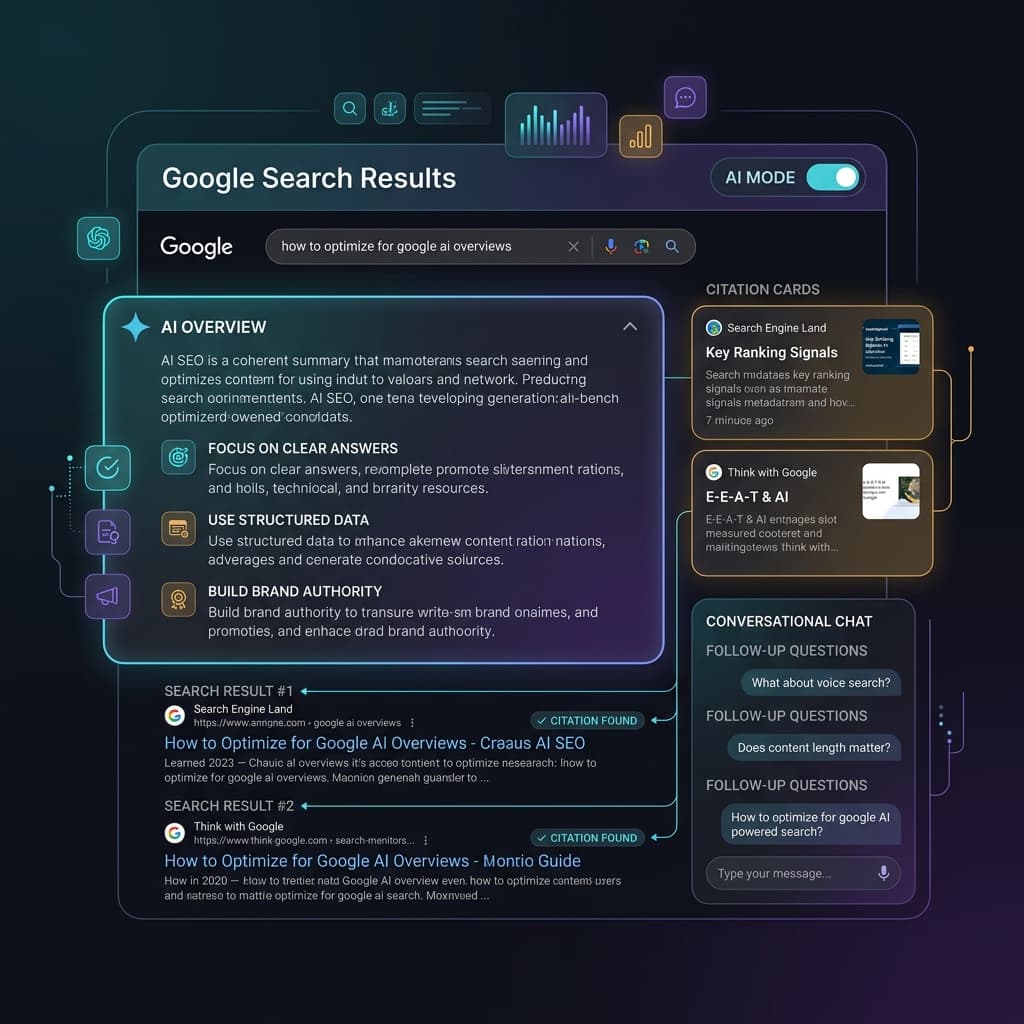
Google AI Overviews and AI Mode SEO: A Practical Visibility Framework (2026)
An in-depth guide to achieving high visibility in Google AI Overviews and AI Mode conversational search. Learn the RAG pipeline, key ranking factors, E-E-A-T requirements, and structured data optimization.

Core Web Vitals Debugging Playbook: Diagnose and Fix LCP, INP, and CLS Issues
Stop guessing why your Core Web Vitals are failing. Learn a systematic debugging workflow for LCP, INP, and CLS issues with real diagnostic techniques, CrUX analysis, and framework-specific fixes.

Internal Linking Strategy for SEO: A Complete Framework
Build an internal linking framework that distributes link equity, establishes content relationships, and drives rankings across your entire site.
Advertisement