SEO for Thin Content: Detection, Recovery, and Prevention
Identify and fix thin content issues that harm your search rankings, with strategies for content consolidation, improvement, and prevention at scale.
Advertisement
Key Takeaways
- Thin content provides little to no value to users and may be deindexed
- Identifying thin content requires both quantitative and qualitative analysis
- Content consolidation merges multiple thin pages into a single comprehensive resource
- 301 redirects preserve link equity when removing thin content
- Prevention requires establishing content quality standards
- AI-generated content requires careful quality control
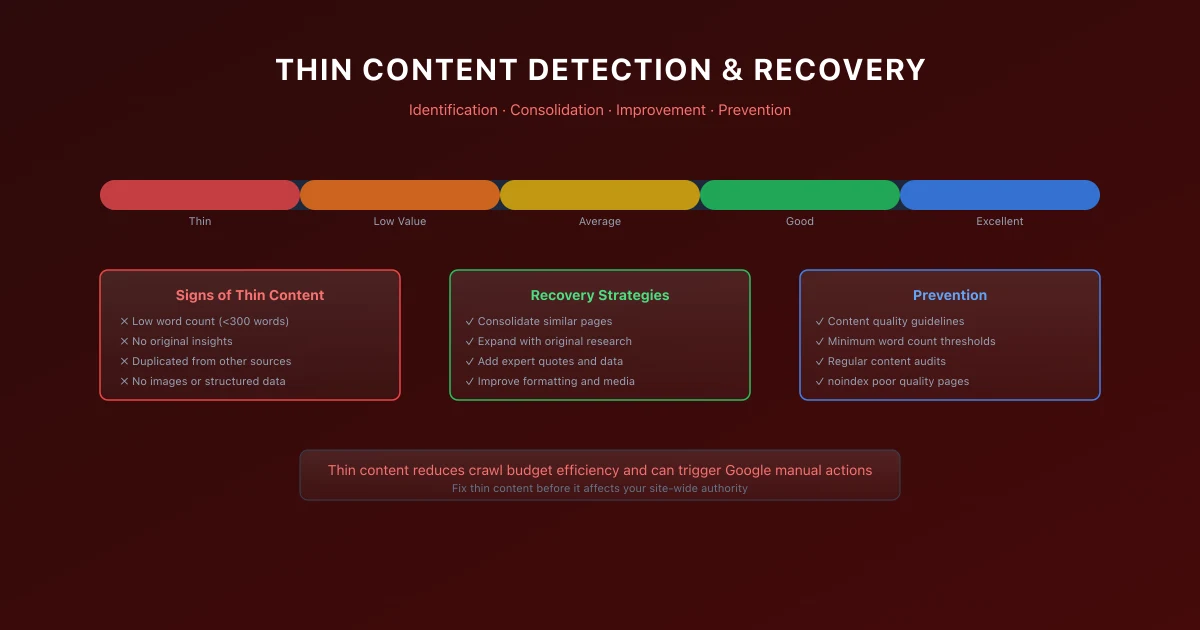
Thin content is one of the most common yet overlooked SEO problems. It describes pages with little or no substantive content that provide minimal value to users. Search engines may devalue or deindex thin content, wasting crawl budget and diluting site authority.
Thin content takes many forms. Auto-generated category pages, product descriptions copied from manufacturers, short blog posts with no original insight, and pages with mostly ads or affiliate links all qualify as thin content. Each type requires a different approach to fix.
What Counts as Thin Content
Google defines thin content as pages with little or no substantive content. The threshold is not a specific word count. A 300-word page that directly answers a user question is not thin. A 2000-word page that rehashes information found on other sites may be thin.
Common types of thin content include:
- →Auto-generated category pages with no original description
- →Pages with mostly ads or affiliate links
- →Content copied from other sources with no added value
- →Pages generated by automated processes with minimal curation
- →Short blog posts that do not cover a topic comprehensively
- →Doorway pages designed to rank for specific queries
Identifying Thin Content at Scale
Finding thin content requires a systematic approach. Start with quantitative analysis, then follow up with qualitative assessment.
Run a crawl of your entire site and export content statistics including word count, heading structure, and internal links. Pages with fewer than 300 words, no heading tags, or no internal links are candidates for thin content review.
Cross-reference thin content candidates with analytics data. Pages with low traffic, high bounce rates, and no conversions are strong candidates for removal or improvement.
Use Google Search Console to find pages with low click-through rates and impressions. These pages may be thin content that Google has chosen not to rank.
Content Consolidation
Content consolidation merges multiple thin pages into a single comprehensive resource. This approach creates stronger content signals and improves user experience.
Identify groups of related thin pages that cover different aspects of the same topic. Merge them into a single pillar page covering the topic comprehensively. Use 301 redirects from the old thin pages to the new consolidated page.
Consolidation benefits SEO in several ways:
- →Creates a single, authoritative resource instead of many weak pages
- →Consolidates link equity from multiple URLs onto one page
- →Reduces crawl waste from thin pages
- →Improves click-through rates with more comprehensive snippets
301 Redirects for Thin Content
When removing thin content, use 301 redirects to preserve link equity. Redirect each thin page to the most relevant existing page on your site. Do not redirect all thin pages to the homepage.
A 301 redirect from a removed thin page passes link equity to the target page. This helps the target page rank while cleaning up your site structure.
After implementing redirects, verify they work correctly. Check for redirect chains and ensure each redirect points to a relevant, high-quality page.
Improving Thin Pages
Some thin pages can be improved rather than removed. Assess each thin page for its potential value.
To improve a thin page:
- →Expand the content with original research, examples, or expert insights
- →Add supporting media like images, videos, or infographics
- →Include internal links to related content
- →Improve the page structure with proper headings
- →Add a clear call to action
AI-Generated Content Risks
AI-generated content has made thin content creation easier than ever. While AI can help produce content at scale, low-effort AI content often falls below quality thresholds.
Google's spam policies specifically address AI-generated content. Content created primarily for search rankings rather than users violates Google's guidelines. AI-generated content that adds no original value is at risk of being classified as thin content.
If you use AI to generate content, ensure human editors review and enhance every piece. Add original examples, expert quotes, and unique insights that AI cannot generate. Use AI as a tool to accelerate human content creation, not replace it.
Quality Thresholds
Establish content quality standards to prevent thin content from being published. Every page should meet minimum quality criteria before going live.
Your quality thresholds should require:
- →Original value that cannot be found on other sites
- →Comprehensive coverage of the topic
- →Clear structure with proper heading hierarchy
- →Supporting evidence, examples, or data
- →Satisfies the search intent for its target keywords
Prevention Strategies
Preventing thin content is easier than fixing it. Establish editorial guidelines, implement content review processes, and monitor content quality continuously.
Use content management workflows that require review before publication. Implement automated checks for minimum word count, heading structure, and internal links. Train content creators to recognize thin content and understand quality standards.
For content strategy support, see our content marketing strategy framework.
For internal linking that supports content quality, see our internal linking strategy guide.
Technical Implementation Steps
- Analyze Current State: Review Google Search Console crawling stats.
- Identify Errors: Filter by 4xx/5xx status codes.
- Map Redirects: Draft 301 redirects maps for any moved URLs.
- Verify Implementation: Run Lighthouse CI/Screaming Frog audit.
- Monitor GSC: Verify Google has updated the index successfully.
Common Mistakes
- →Blocking JavaScript & CSS in robots.txt: Googlebot needs to render layout styles to calculate Core Web Vitals like CLS and LCP accurately.
- →Not Preloading Critical Hero Images: Forgetting to preload the LCP image delays rendering, resulting in a poor Lighthouse speed score.
- →Ignoring Client-Side Render Latency: Relying entirely on client-side JS executing without an HTML backup blocks indexation on other search engines like Bing.
When This Does Not Apply
- →Static Marketing Pages: Simple, light static sites with minimal dynamic elements rarely need complex server-rendering, database connections, or API performance strategies.
- →Non-Indexed Portals: Staging sites, dashboard pages behind authentication, or internal company wikis do not benefit from structured data or search engine indexability optimization.
Official References
Advertisement
Frequently Asked Questions
What is the minimum word count for good SEO?
There is no minimum word count. Content should be as long as needed to cover the topic comprehensively. Some topics require 300 words. Others need 3000.
Can AI content be penalized by Google?
AI content that provides no original value may be classified as thin content. AI content reviewed and enhanced by human editors faces lower risk.
Should I delete thin content or improve it?
Improve thin content when the topic has search demand and you can add value. Delete or redirect thin content that does not serve user needs.
How often should I audit for thin content?
Conduct a thin content [audit](/blog/technical-seo-audit-checklist) quarterly. Monitor content quality continuously through analytics and search performance data.
Do noindex pages count as thin content?
Noindex pages do not affect search rankings because they are excluded from the index. However, they still consume server resources and may confuse users.

Full-Stack Developer & Web Architecture Engineer
Liam O'Brien is a Full-Stack Developer with 8+ years of experience building high-performance web applications. He specializes in Next.js, React, and Node.js, with a deep focus on web architecture, performance optimization, and technical SEO. Liam has architected front-end systems for e-commerce platforms handling 10 million+ monthly visitors and has contributed to major open-source projects including Next.js core and React documentation. He is passionate about server-side rendering, edge computing, and building scalable web applications that deliver exceptional user experiences. Liam writes about modern JavaScript frameworks, performance patterns, web vitals optimization, and building for search engine crawlers. He believes that great engineering and great SEO go hand in hand.
Comments are temporarily unavailable.
Stay Updated
Get the latest articles and SEO insights delivered to your inbox.
No spam. Unsubscribe anytime.
Related Articles
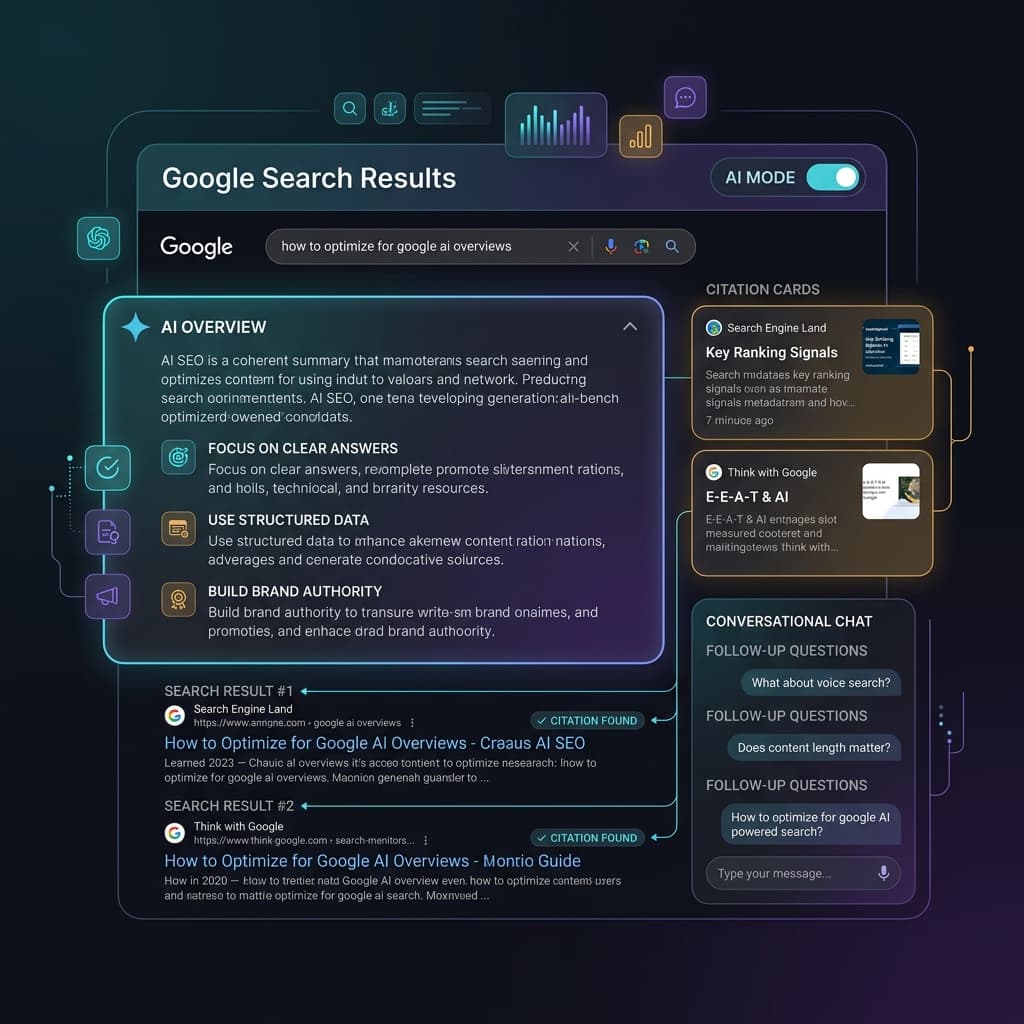
Google AI Overviews and AI Mode SEO: A Practical Visibility Framework (2026)
An in-depth guide to achieving high visibility in Google AI Overviews and AI Mode conversational search. Learn the RAG pipeline, key ranking factors, E-E-A-T requirements, and structured data optimization.

AI SEO Content Writing: Guide to Quality & Google E-E-A-T (2026)
How to use AI content writing tools (ChatGPT, Claude) for SEO without violating Google Helpful Content guidelines or losing E-E-A-T trust factors.

Core Web Vitals Debugging Playbook: Diagnose and Fix LCP, INP, and CLS Issues
Stop guessing why your Core Web Vitals are failing. Learn a systematic debugging workflow for LCP, INP, and CLS issues with real diagnostic techniques, CrUX analysis, and framework-specific fixes.
Advertisement